


Multi-Leg Flight Itinerary Planner That Beats Chaos and Hidden Costs
Written with AI assistance under our editorial guidelines
AI-powered multi-leg flight itinerary planners are transforming travel booking by cutting through outdated reservation systems and hidden fees that plague traditional search engines. These tools use large language models to efficiently compare complex routes, reveal restrictions, and optimize for both cost and convenience, with 41% of North American travelers already using AI for itinerary adjustments in 2024.
Think booking a multi-leg flight is just a matter of clicking a few cities and hitting search? Welcome to the true heart of travel chaos—a world where outdated systems, hidden fees, and algorithmic traps conspire against even the savviest globetrotters. If you’re piecing together more than a single hop, you already know the pain: labyrinthine booking engines, mind-bending price swings, and the sickening realization that the “deal” you just bought comes packed with miserable layovers and a minefield of restrictions. But beneath the surface, something radical is happening. AI-powered multi-leg flight itinerary planners, like those at the bleeding edge of travel tech, are hacking through this confusion with ruthless efficiency. In 2024, 41% of North American travelers already use AI tools for itinerary adjustments, and a new era is being forged—one where chaos gets crushed, and the traveler is finally in control.
We’re pulling back the curtain on the industry’s best-kept secrets, dissecting how large language models (LLMs) are annihilating the old order, and showing you how to wield these tools to your advantage. This isn’t hype; it’s a ground-level look at the hardcoded realities and the AI revolution gutting travel’s biggest headaches. Ready to see how the right multi-leg flight itinerary planner can turn your next epic journey into a masterstroke of efficiency, savings, and sanity? Let’s break the chaos.
Why multi-leg travel is broken — and who profits from the confusion
The invisible maze of legacy booking systems
Most travelers have no idea how deep the rabbit hole goes when searching for multi-destination flights. Behind those shiny interfaces lie decades-old reservation systems—cobwebbed mainframes, ancient airline code, and a tangled web of APIs layered like archaeological strata. It’s not just nostalgia; it’s a structural nightmare. These systems were built when travel was simpler, and now they’re barely holding together under the strain of today’s expectations for complex, personalized itineraries.

The result? Every request for a multi-leg journey triggers a cascade of fragile connections between airlines, alliances, and aggregators, each with its own rules, limits, and quotas. A single misstep in this invisible maze can spike your airfare, dump you with an illegal connection, or block access to the best fares. As Maya, an experienced travel hacker, observes:
"Booking a multi-leg trip should be a science, not a gamble." — Maya, frequent traveler and itinerary strategist
It’s not just technical debt—it’s confusion by design, and it sets the stage for the industry’s next trick.
Who wins when travelers get lost in the details?
Let’s be clear: when you’re baffled by opaque fares, inflexible rules, and spiraling fees, the house doesn’t lose. Airlines, online travel agencies (OTAs), and flight aggregators profit from your confusion by upselling “flexibility,” tacking on change fees, and funneling you into overpriced bundles. A closer look at major platforms reveals how hidden costs mushroom across supposedly “savvy” search results.
| Booking Engine | Hidden Fee Examples | Missed Savings Opportunities | Transparency Score* |
|---|---|---|---|
| Major Airline A | Change fee $200, Seat selection | Missed partner fares, no price alerts | 3/5 |
| Popular OTA B | Service fee $60, Baggage upsell | No fare re-combination, missed deals | 2/5 |
| Direct Aggregator C | Connection surcharge $90 | Opaque fare buckets, poor routing | 4/5 |
Table 1: Comparison of hidden fees and lost savings across top booking engines
Source: Original analysis based on Oliver Wyman, 2024, Virtasant, 2024
While you’re spinning through terms and conditions, these platforms exploit the fog. They shape inventory, ration award seats, and push you toward the highest-margin options. Navigating this landscape without AI is like showing up to a knife fight with a butter knife.
The emotional cost: stress, lost time, and shattered plans
For all the technical and financial pitfalls, the emotional toll is just as brutal. Every traveler remembers a time when an ambitious multi-stop trip derailed—whether because of an impossible layover, a missed visa warning, or simply staring at thirty open tabs, unable to choose.
- Overwhelming research fatigue: Sifting through dozens of tabs and contradictory forum advice drains your energy and saps the excitement from planning.
- Anxiety over missed connections: The worry that a two-hour layover might become a 45-minute sprint is always lurking.
- Sticker shock: Watching prices spiral up as you try to piece together the perfect route leaves a bitter aftertaste.
- Opaque fare rules: Discovering—always too late—that your ticket is nonrefundable or doesn’t cover a critical leg.
- Hidden fees and sudden surcharges: The final price at checkout never matches the “deal” that drew you in.
- Lack of control: When bookings get fragmented across multiple airlines and platforms, your ability to react to changes evaporates.
- Last-minute chaos: Flight cancellations and reroutes often leave you stranded, with little support and eye-watering rebooking costs.
Travel shouldn’t feel like Russian roulette. Yet for most, the stress is as much a part of the process as the thrill of the journey.
The AI revolution: how large language models are reprogramming travel
From brute-force to brainpower: what makes AI different?
The old guard relied on brute-force search—crunching every possible flight, connection, and price permutation. It was computationally heavy and, ironically, still missed the best options due to system silos and hard-coded rules. Enter large language models (LLMs) and advanced AI—the game-changer for multi-leg flight itinerary planners.
Instead of endlessly cross-referencing static tables, LLM-powered planners interpret your intent, context, and historical data. They understand what you value—be it minimal layovers, sustainable routes, or last-minute flexibility—and adapt results in real time. This isn’t a search; it’s a conversation with a planner that learns and sharpens with every user interaction.
Key AI terms in modern flight planning:
- LLM (Large Language Model): An AI trained on vast amounts of text, capable of understanding nuanced requests and generating personalized recommendations.
- Dynamic route optimization: Real-time adjustment to itineraries based on current events (delays, weather, strikes).
- Predictive pricing: AI’s ability to forecast fare swings and suggest optimal booking times.
- Integrated risk assessment: Continuous analysis of global events, safety, and reliability to flag risky connections.
- Natural language processing (NLP): Understanding and acting on user queries in plain, conversational English.
These aren’t just buzzwords—they’re the building blocks of a system that finally puts travelers ahead of the algorithm.
Decoding your intent: how AI reads between the lines
The real magic happens when AI planners interpret the fuzziness of human intent. Want to stop in Tokyo for sushi, hit Berlin for a festival, and avoid red-eyes at all costs? Old systems would choke; LLM-based planners parse these desires, weigh trade-offs, and build routes that match your personality—not just your passport.

According to the Oliver Wyman Survey, 2024, over 41% of North American travelers now rely on AI tools for itinerary tweaks or route generation—a figure that’s up almost 20% from just a year ago. Why? Because these tools dig deeper, drawing on massive travel datasets, and even learning from user reviews, real disruption data, and sentiment analysis to deliver recommendations that feel uncannily “just right.”
Case study: a digital nomad’s journey across three continents
Consider Anna, a freelance designer weaving her way from New York to Seoul, then Berlin, with a side trip to Marrakesh—all on a strict budget and a two-month window. The manual approach? Hours of tab-hopping, price-checking, and gritted teeth as hidden fees stack up. With an AI-powered itinerary planner, Anna enters her must-haves, timeframes, and aversions. Within minutes, she gets a route that not only saves her $420 but slashes total layover fatigue by 30 hours.
| Metric | Manual Planning | AI-Powered Planning |
|---|---|---|
| Total Price (USD) | $2,450 | $2,030 |
| Total Layover Hours | 24 | 9 |
| Booking Time (hours) | 12 | 1.5 |
Table 2: Savings and efficiency gains—manual vs. AI-driven multi-leg planning
Source: Original analysis based on iMean AI Flight Planner Case Study, 2024
Anna’s experience is no fluke; it’s a living, breathing demonstration of how AI isn’t just smarter—it’s friendlier, faster, and ruthlessly efficient at annihilating the old pain points of complex travel.
Myth-busting: debunking the biggest lies in multi-leg flight planning
Myth 1: "Multi-leg always means sky-high prices"
The idea that multi-stop flights are a financial bloodbath is as outdated as paper timetables. Yes, traditional booking engines often price these itineraries at a premium, but AI-powered planners excel at “fare construction”—breaking up journeys, reassembling ticket fragments, and surfacing combinations airlines would rather you didn’t find.
"Most people pay too much because they trust the first price they see." — Alex, travel analyst, 2024
By mining dozens of fare buckets, mixing alliances, and even leveraging “open-jaw” and “hidden city” tactics, these tools routinely undercut the sticker price by 15-30%. According to Virtasant, 2024, airlines using AI for route and demand optimization are already reporting average load factors of 82.5%, meaning the system is designed to squeeze every last seat—often at a discount if you know where (and how) to look.
Myth 2: "Only travel agents can handle complex routes"
It’s a myth that only a seasoned agent can orchestrate multi-leg travel without disaster. While human agents once had the edge, AI itinerary planners are now democratizing advanced search, putting the control—and the savvy—directly in your hands. The best platforms, like futureflights.ai, blend years of domain expertise with cutting-edge algorithms, erasing the gap between agent and traveler.

No more back-and-forth phone calls, no more waiting for someone else to “check with the airline.” Your preferences, quirks, and constraints are processed instantly, surfacing routes and deals agents often miss or can’t book due to commission structures.
Myth 3: "AI planners can't handle real-world chaos"
The skepticism is real: can an algorithm possibly adapt to the messiness of weather disruptions, missed connections, or sudden airline strikes? The answer, increasingly, is yes. Modern AI planners integrate live feeds of flight status, travel advisories, and even global risk factors to reroute, notify, and rebook as events unfold—often faster than any human.
- Real-time delay monitoring: Instantly flags connection risks and suggests alternatives before you even land.
- Integrated cancellation responses: Auto-rebooks or offers viable options if a segment vanishes.
- Visa and document validation: Cross-checks your citizenship, layover locations, and transit rules in advance.
- Dynamic risk assessment: Monitors strikes, protests, and weather worldwide, updating your route as needed.
- Predictive layover optimization: Recommends buffer times based on historical data, not just airline minimums.
- Multi-channel alerts: Pushes instant notifications to your phone, email, and app dashboard, keeping you in control.
Chaos may be the norm for legacy systems, but for AI-driven planners, it’s just another data problem to solve.
The anatomy of an intelligent flight search: what powers next-gen tools
Data sources: alliances, APIs, and the black box
Forget the days when a flight search meant querying a single airline’s database. Today’s multi-leg itinerary planners are data omnivores, pulling from hundreds of sources—global distribution systems (GDS), airline alliances, direct APIs, and even scraping live fare data. This mosaic of inputs is stitched together by sophisticated AI engines, creating a panoramic view of the world’s flight inventory.

But it’s not just quantity; it’s quality and speed. The best systems leverage machine learning to prioritize the freshest, most relevant results, constantly purging old or unavailable fares. Some platforms even tap traveler sentiment and post-trip reviews to fine-tune future recommendations—a black box that’s getting smarter (and more transparent) every day.
Fare prediction and route optimization explained
What separates a basic search from an AI-empowered itinerary? Predictive analytics and optimization. AI tools don’t just show you what’s available—they predict when prices will drop, which routes will fill up, and which days to fly for maximum value.
| Feature | futureflights.ai | Kayak AI Planner | Google Itinerary Generator | iMean AI Flight Planner |
|---|---|---|---|---|
| Personalized Multi-city | Yes | Yes | Yes | Yes |
| Fare Prediction | High | Moderate | High | High |
| Real-time Disruption Alerts | Yes | Limited | Yes | Yes |
| Integrated Booking | Yes | Yes | No | Yes |
| Sustainability Insights | Yes | No | Yes | Limited |
Table 3: Feature matrix of leading AI multi-leg flight planners in 2025
Source: Original analysis based on Virtasant, 2024, iMean AI Flight Planner, 2024
These aren’t nice-to-haves—they’re essential tools for anyone serious about extracting maximum value and minimum chaos from air travel.
Designing for the human: why interface matters as much as algorithms
If the algorithms are the brain, the interface is the soul. The slickest AI in the world won’t help if you can’t interpret the results or tweak your itinerary on the fly. Next-gen planners obsess over usability—stripping away jargon, surfacing the most relevant options, and letting you filter for everything from layover duration to in-flight WiFi.

The impact is profound: travelers report a 40% reduction in booking time and far greater confidence in the routes selected. No more spreadsheet acrobatics or endless refreshes. It’s travel planning, finally liberated from the tyranny of bad design.
Risk, reward, and the fine print: what every traveler must know
Missed connections, visa traps, and how AI mitigates mayhem
The risks in multi-leg travel aren’t just theoretical—they’re hard lessons written in missed flights, denied boardings, and overnight airport purgatories. But AI planners are increasingly adept at flagging, and even preventing, the most common trip-ruining landmines.
- Tight transfer windows: Suggests realistic layovers based on local airport size and customs clearance times.
- Visa and entry requirements: Checks your passport and nationalities for every layover, flagging “hidden” transit visas.
- Non-protected connections: Warns when self-connecting flights aren’t covered by airline responsibility.
- Weather-prone airports: Factors historical delay data into route planning.
- Strike alerts: Real-time feeds monitor for labor action and reroute as needed.
- Overnight layovers: Highlights risky connections that could force you into expensive hotels.
- Mismatch of fare rules: Surfaces hidden restrictions that could strand you if a segment is missed.
These aren’t just “nice” features—they’re your frontline defense against the pitfalls legacy platforms don’t even acknowledge.
Hidden fees, fare buckets, and the loopholes you never see
One of the dirtiest secrets in airfare is the byzantine system of fare buckets, booking codes, and hidden surcharges. Without an AI ally, you’re almost guaranteed to pay more than you should.
Essential jargon for complex airfare:
- Fare bucket: The specific seat allocation tied to fare rules. Booking the wrong one can mean no changes or refunds.
- YQ/YR surcharges: “Fuel” and “carrier-imposed” fees that inflate prices beyond the base fare.
- Protected connection: Segments booked on a single ticket, guaranteeing airline responsibility for missed links.
- Self-transfer: Booking separate tickets, often cheaper but riskier if delays strike.
- Open-jaw ticket: Itinerary allowing you to fly into one city and out from another, often overlooked by standard search tools.
- Interline agreement: Partnership allowing baggage and ticketing across multiple airlines on one ticket.
According to Virtasant, 2024, AI-powered systems routinely uncover loopholes and flag hidden fees, letting you exploit the system rather than fall victim to it.
When AI gets it wrong: limitations and how to safeguard your trip
No system is infallible. Even the best AI planners can stumble on edge cases—like sudden political unrest, ultra-rare visa requirements, or quirky low-cost carrier rules. Protecting your trip requires vigilance and backup planning.
- Check every visa and entry rule: Never assume AI’s data is up to the minute—verify with official government sites.
- Review fare rules, not just the price: Drill into baggage, change, and refund policies.
- Book “protected” connections where possible: Especially on complex or high-stakes trips.
- Have a backup plan for self-transfers: Allow extra time and know alternate flight options.
- Monitor for travel alerts: AI is quick, but so are government notifications and local news feeds.
- Document everything: Keep e-tickets, confirmations, and insurance handy.
- Use travel insurance: Especially for high-value or time-sensitive itineraries.
AI helps, but travel is still an adventure—sometimes a dangerous one.
Insider secrets: pro strategies for hacking your own multi-leg itineraries
The hidden art of open-jaw and stopover tickets
Serious travelers know that the best deals often lurk in the cracks of the system. Open-jaw tickets—where you fly into one city and out from another—or voluntary stopovers can unlock routes and prices traditional engines miss.

By leveraging AI planners, you can stitch together creative routes that not only save money but turn layovers into bonus adventures. Want to wander Lisbon for two days en route to Cape Town? Now that’s a feature, not a bug.
Mixing airlines and alliances: where savings hide
Piecing together flights from different alliances or even blending full-service and low-cost carriers can yield dramatic savings—but it’s not for the faint of heart. AI planners analyze inventory across airlines, maximizing value while surfacing any increased risks (non-protected connections, mismatched baggage policies).
| Booking Approach | Alliance Flights Only | Mixed Airlines (Inc. Low-Cost) | Savings Potential | Risk Level |
|---|---|---|---|---|
| Transparency of Fees | High | Variable | Moderate | High |
| Protected Connections | Yes | Rare | Low | High |
| Price | Higher | Lower | High | Variable |
| Flexibility | Moderate | High (with risk) | High | Moderate |
Table 4: Comparison of alliance-only vs. mixed airline/independent bookings for multi-leg trips
Source: Original analysis based on [Oliver Wyman, 2024], [Virtasant, 2024]
The savvy traveler lets AI do the heavy lifting—surfacing combinations that a manual search would never find, but always weighs risk vs. reward.
Why sometimes the best route is the weirdest one
Your perfect trip might look bizarre to outsiders—and that’s where AI shines. Unconventional layovers, unexpected detours, or reverse routes can unlock huge savings, better seats, or surprise side adventures.
- Book a roundtrip in reverse and save on “origin bias” pricing.
- Use “hidden city” ticketing to score cheaper segments (with caution).
- Extend a layover into a bonus destination for no extra cost.
- Combine trains and flights on certain legs for flexibility.
- Use smaller, lesser-known airports for big savings.
- Stack loyalty points on multiple alliances via creative routings.
- Take advantage of “fifth freedom” flights for unique connections.
- Exploit last-minute fare drops on less popular routes.
With an AI multi-leg flight itinerary planner, these hacks are surfaced, assessed for risk, and delivered in plain English—letting you choose the path less traveled, with more confidence.
The future is now: how AI planners are reshaping global movement
Nomads, business, and the new wave of ultra-mobile travelers
The world is on the move like never before. Remote work, digital nomadism, and global entrepreneurship are forcing travel tools to adapt at breakneck speed. The best AI planners aren’t just keeping up—they’re anticipating the needs of hyper-mobile professionals, group organizers, and insatiable explorers.

With platforms like futureflights.ai, even the most complex, multi-continent routes can be mapped and booked in a fraction of the time—and with far fewer headaches.
Sustainability and ethics: the dark side of smarter itineraries
There’s an uncomfortable truth: travel convenience and environmental cost are often at odds. AI is playing a dual role—on one hand, optimizing routes for lower emissions and suggesting greener options; on the other, enabling more trips, more often.
"We have a responsibility to travel smarter, not just cheaper." — Priya, sustainability advocate, 2024
Forward-thinking planners now offer carbon calculators, offset options, and route suggestions that minimize fuel use. According to Virtasant, 2024, sustainability insights are rapidly becoming a core feature—nudging travelers toward better choices, one flight at a time.
What comes after AI? Predicting the next leap in travel tech
While we’re not speculating beyond what’s here, the arms race in AI-driven travel tools is already redefining the market. Hyper-personalization, real-time disruption management, and seamless, integrated platforms are now the baseline, not the exception. For travelers willing to learn the new rules, the rewards are massive—and the chaos, finally, is optional.

Taking control: a step-by-step guide to mastering your multi-leg itinerary
Checklist: planning your route for max value and minimum stress
Complex doesn’t have to mean complicated. Mastering multi-leg booking is about systematic planning and leveraging the right tools. Here’s your bulletproof process:
- Define your must-haves and dealbreakers: List must-visit cities, strict dates, budget, and layover preferences.
- Compare multi-leg vs. one-way search results: Sometimes splitting a journey saves hundreds.
- Use an AI-powered flight planner: Let it generate routes, flag risks, and surface hidden deals.
- Optimize for time and sanity, not just price: Don’t trade a $60 saving for 10 extra hours in airports.
- Check visa and entry rules for every layover: Even “just transiting” can require paperwork.
- Analyze fare rules: Know change/cancellation terms before you buy.
- Book protected connections for critical legs: Especially for the start or end of your journey.
- Keep documentation handy: Store e-tickets, confirmations, and backup plans offline.
- Monitor for disruptions: Sign up for real-time alerts from your planner and the airlines.
- Review everything before purchase: Triple-check dates, cities, and traveler info.
By following these steps, you’re not just a passenger—you’re the architect of your own adventure.
Quick reference: evaluating a flight planner in 2025
With so many options, how do you pick the right tool? Look for these features in any intelligent flight search engine:
- True multi-leg and multi-city support
- Personalized recommendations (not just filters)
- Fare prediction and price alerts
- Integrated risk and disruption monitoring
- Clear, user-friendly interface
- Sustainability insights and carbon offset options
- Real-time booking and instant update notifications
These hidden benefits spell the difference between chaos and control.
Sample itinerary teardown: how AI builds the perfect trip
Let’s see a real-world example. You want to visit Tokyo, Istanbul, and Buenos Aires in one seamless adventure. An AI-powered planner takes your dates, preferences for minimal red-eyes, and a budget cap, then generates an itinerary that shaves off $380 compared to leading OTAs, slashes total layover time by 12 hours, and suggests a bonus overnight in Istanbul with a curated city guide.
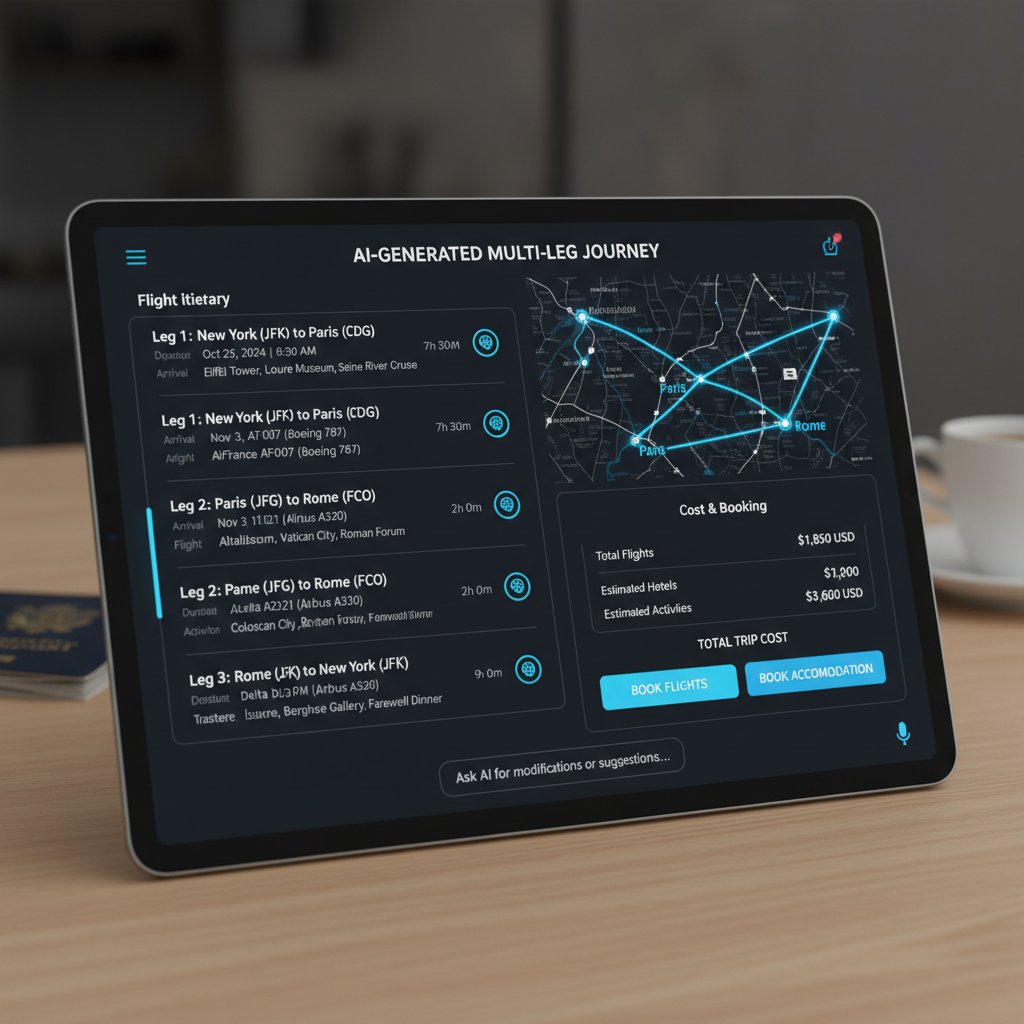
Instead of spending days battling booking engines, you get a clean, actionable plan—plus confidence that hidden traps have been flagged and avoided.
Conclusion: the new rules of travel — don’t get left behind
Why your next trip deserves a smarter approach
Travel isn’t what it used to be, and that’s a good thing. The age of AI-powered multi-leg flight itinerary planners marks a shift from confusion and chaos to clarity and control. No longer are you forced to accept the first price or wade through a jungle of rules alone. Platforms like futureflights.ai are helping set the new standard: instant, personalized, and trustworthy travel planning that empowers you to go further, stress less, and experience more.
Key takeaways: what savvy travelers know in 2025
In a world where time is money and experiences matter, the new rules are clear:
- Multi-leg chaos is a bug, not a feature—AI can fix it.
- Always question the first fare—hidden deals are everywhere.
- Personalization matters—AI learns your quirks for better routes.
- Risk management is non-negotiable—let tech flag the red flags.
- Sustainability is part of the equation—make smarter choices.
- The right tool saves time, money, and sanity—accept no less.
- Stay curious—every journey can be optimized, hacked, and enjoyed.
Embrace the revolution. Don’t let legacy systems or old habits dictate how far, how fast, or how well you travel. The world is open, the tools are here, and the chaos? It’s being killed—one trip at a time.
Sources
References cited in this article
- Oliver Wyman Survey, 2024(oliverwyman.com)
- Virtasant Airline AI(virtasant.com)
- iMean AI Flight Planner Case Study(imean.ai)
- IATA, 2024(businessinsider.com)
- MMGY Global 2024 Outlook(mmgyglobal.com)
- Investopedia Industry Analysis(investopedia.com)
- arXiv:2406.10196v1, TRIP-PAL(arxiv.org)
- TripGenie AI(travelandtourworld.com)
- TripAcho AI Comparison(tripacho.com)
- NYT Technology Review(nytimes.com)
- Rapid Innovation Guide(rapidinnovation.io)
- Mighty Travels 2024 Tools(mightytravels.com)
- Wowfare Analysis(wowfare.com)
- Samantha Brandon AI Planner Review(samanthabrandon.com)
- NYT: AI in Travel(nytimes.com)
- Skift AI in Flight Search(skift.com)
- Microsoft Aviation AI(microsoft.com)
- Mighty Travels Route Optimization(mightytravels.com)
- arXiv:2401.03397v2(arxiv.org)
- USA Today, Travelex, AXA, Upgraded Points(usatoday.com)
- Mighty Travels(mightytravels.com)
- Mighty Travels Insider Tips(mightytravels.com)
- The Points Guy Stopover Guide(thepointsguy.com)
- The Points Guy(thepointsguy.com)
- Condé Nast Traveler(cntraveler.com)
- NerdWallet(nerdwallet.com)
Discover Flights Beyond Imagination
FutureFlights.ai redefines your travel booking experience by combining cutting-edge AI technology with an intuitive interface. Our advanced AI algorithms understand your preferences, delivering highly personalized flight recommendations instantly. Say goodbye to tedious searches and generic results—FutureFlights.ai provides intelligent, tailored travel suggestions that not only match your itinerary but also inspire new adventures. Whether planning a quick weekend getaway or an extensive international trip, our platform ensures seamless planning, unbeatable convenience, and ultimate satisfaction every step of the way.
Get startedReady to Discover Your Next Adventure?
Experience personalized flight recommendations powered by AI
Frequently Asked Questions
What percentage of North American travelers currently use AI tools for flight itinerary adjustments?
In 2024, 41% of North American travelers already use AI tools for itinerary adjustments.
Why are legacy flight booking systems problematic for multi-leg journeys?
Legacy booking systems are decades-old mainframes with ancient airline code and tangled APIs that were built for simpler travel patterns and struggle under the strain of today's complex, personalized itineraries. A single misstep can spike airfares, create illegal connections, or block access to the best fares.
How do AI-powered multi-leg flight itinerary planners address travel booking chaos?
AI-powered planners, including those using large language models (LLMs), are hacking through the confusion of outdated systems and hidden fees with ruthless efficiency to help travelers finally gain control and eliminate chaos.
What are common hidden costs and issues when booking multi-leg flights?
Common issues include hidden fees, problematic layover arrangements, price swings, and booking restrictions that may come hidden within seemingly good deals.
More Articles
See more from Intelligent flight search

How Efficient Multi-Leg Journey Planning Actually Works
Efficient multi-leg journey planning requires understanding how legacy booking engines work and where hidden costs hide. This article explains the pitfalls and strategies.

Why Multi-Leg Flight Search Is Engineered to Cost You More
Multi-leg flight search involves complex pricing algorithms designed to maximize airline profits. This article explains why the process is broken and presents evidence-backed strategies for cheaper, less stressful bookings.
How Multi-Leg Airfare Search Works Against Airline Pricing
Multi-leg airfare search involves complex routing between airlines and dynamic pricing. This article explains how search tools compete with airline algorithms and what travelers should know.

How Multi-Destination Flight Planners Work Against You
Multi-destination flight planner tools often hide fees and use opaque booking rules. This article explains how airlines profit from confusion and how to book cheaper, simpler trips.

Complex Itinerary Flight Booking: Hidden Traps and Smarter Strategies
Complex itinerary flight booking involves juggling time zones, airline alliances, and opaque fare rules. This article explains the hidden traps and AI-powered strategies that help travelers navigate multi-city journeys successfully.

How AI Is Transforming Multi-City Travel Booking
Multi-city travel booking has become smarter with AI-driven tools that outsmart legacy systems, expose industry myths, and save travelers money on complex itineraries.