


AI-Driven Travel Personalization and How to Beat the Algorithm
Written with AI assistance under our editorial guidelines
AI algorithms now shape 41% of North American travelers' trip planning decisions, with 75% trusting AI for accommodation choices. The global AI-in-travel market reached $131.7 billion in 2023, with over 80% of major travel agencies integrating AI-driven personalization. These systems filter search results and recommendations through proprietary lenses reflecting both individual preferences and broader behavioral patterns, fundamentally controlling what travelers see and consider.
Forget the glossy promise of wanderlust-fueled freedom. If you think your last travel decision was made with unfiltered autonomy, think again. In the era of AI-driven travel personalization, the script for your next journey may have been written long before you typed a single destination into a search bar. The invisible hand behind the curtain? A mesh of neural networks, behavioral signals, and data points you barely realize you’re leaving behind. The transformation is so profound that, as of March 2024, a staggering 41% of North American travelers already relied on generative AI for trip planning. What’s more, 75% say they trust AI to pick their accommodation—a seismic shift from the days of endless scrolling and anxious cross-checking. This isn’t hype—it’s a fundamental rewriting of how choices are made, and it’s happening at breakneck speed.
AI’s grip on the travel industry is no longer about convenience; it’s about control, curation, and sometimes, letting go of the illusion of randomness. The global AI-in-travel market, valued at $131.7 billion in 2023, is on a trajectory that dwarfs even the most ambitious of tech sectors. This article tears open the black box, exposing how algorithms now shape not just what you see, but what you crave, where you land, and—maybe most unsettlingly—what you miss. Whether you’re a die-hard deal hunter, a spontaneous explorer, or someone who just wants a stress-free booking, it’s time to meet the digital twin you never asked for and outsmart the machine before it outsmarts you.
The algorithm behind your ticket: a new era of travel
How AI hijacked the travel industry
There was a time when trip planning involved a stack of guidebooks, a few late-night calls to airlines, and an atlas that never quite closed right. Now, a few keystrokes summon a barrage of "personalized" recommendations, courtesy of algorithms that know you better than your travel agent ever did. According to Skift Research, 2024, more than 80% of major online travel agencies have integrated some form of AI-driven personalization into their platforms. The result? Your search results, destination suggestions, and even the deals you see are filtered through a proprietary lens that reflects not just your preferences but millions of others’ behaviors as well.

But the real coup is subtler. AI is the unseen force nudging your choices, determining which "hidden gems" make it onto your radar and which are buried beneath a deluge of data. This level of curation is often welcomed by travelers intent on efficiency, yet it raises profound questions about agency. As Jamie, a travel tech analyst, bluntly puts it:
"Most people think they’re choosing their trip. In reality, the algorithm is choosing them." — Jamie, travel tech analyst
The implications cut deeper than mere convenience—they touch on the very core of who gets to decide what constitutes adventure, comfort, or risk.
From chaos to curation: the promise of AI-driven personalization
Scroll through the endless options for flights, hotels, and experiences, and it’s easy to feel paralyzed. The paradox of choice is all too real—research from McKinsey, 2024 confirms that 68% of travelers have abandoned bookings due to information overload. This is where AI steps in, promising to slice through the noise and deliver only what matters.
The following table breaks down how AI-driven flight search stacks up against traditional methods:
| Criteria | Traditional Flight Search | AI-driven Flight Search |
|---|---|---|
| Speed | Slow (manual comparisons) | Instant, filters vast options |
| Relevance | Mixed, generic results | Highly personalized matches |
| User Satisfaction | Moderate, often frustrating | High, streamlined experience |
| Hidden Costs | Frequent surprises | AI flags or predicts costs |
Table 1: Traditional vs AI-driven flight search. Source: Original analysis based on McKinsey, 2024 and Skift Research, 2024.
By leveraging massive datasets and machine learning, platforms like futureflights.ai are redefining not just the booking experience, but the very expectations travelers bring to the process—speed, accuracy, and a sense of discovery are all being recalibrated by algorithms that learn and adapt with each click.
The rise of intelligent flight search engines
The race to provide smarter, more intuitive travel experiences has given rise to a new breed of flight search engines, led by innovators like futureflights.ai. These platforms don’t just sort flights—they predict, recommend, and even anticipate needs you haven’t voiced.
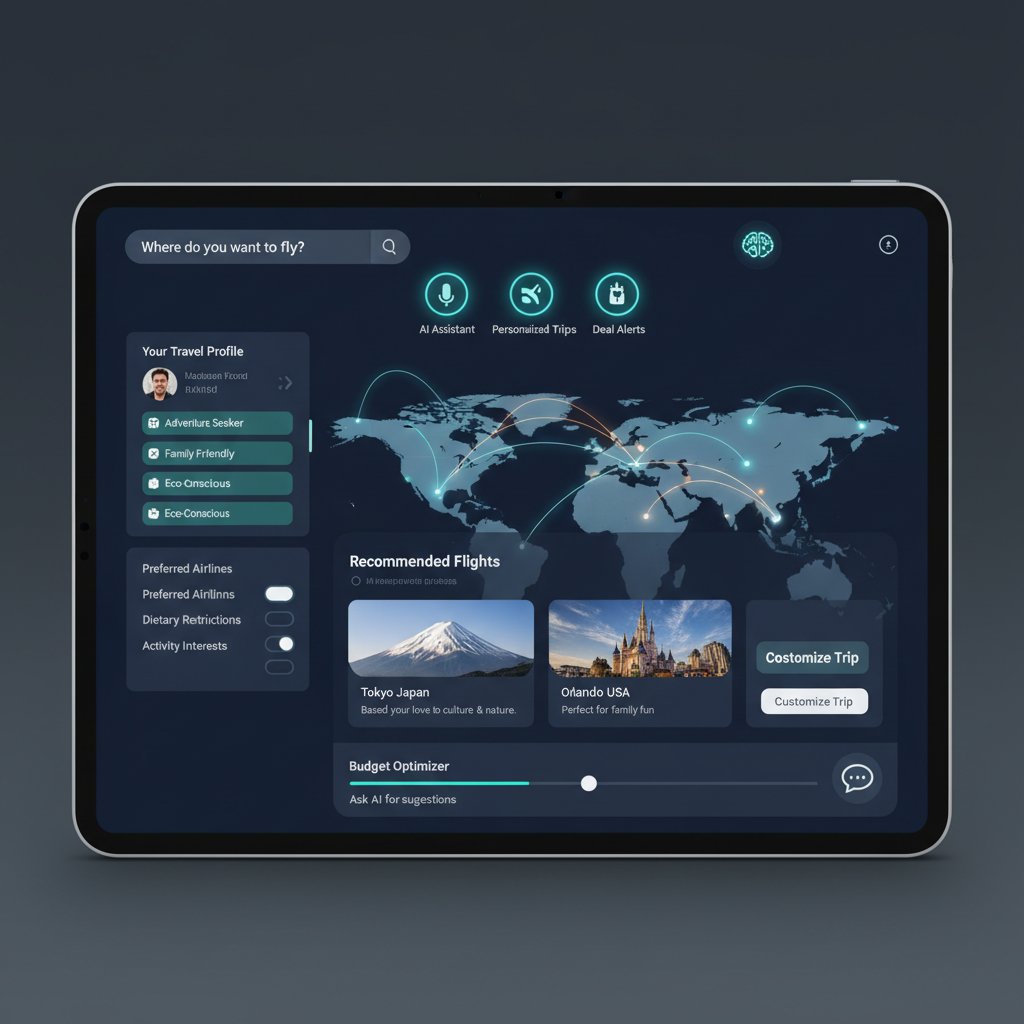
AI-powered engines scan vast swathes of data—fare trends, user reviews, weather patterns, even social signals—to deliver not just options, but "intelligent" suggestions tailored to your profile. According to Phocuswright, 2025, 85% of travel businesses now rely on automated support, and platforms like futureflights.ai are leading this charge by offering an interface that feels less like a search engine and more like a digital concierge. The result? Less time spent sifting through irrelevant results, and more time exploring possibilities you might never have considered.
Inside the black box: how AI personalizes your journey
What data really feeds the machine?
The bedrock of AI-driven travel personalization is data—mountains of it, harvested from sources as varied as your previous searches, booking patterns, location data, social media activity, and even behavioral signals captured during your browsing sessions. According to Travelport, 2024, every query you make, every filter you apply, and every page you linger on is a data point informing the next round of recommendations.
Here’s a decoding of the lingo:
The underlying goal or purpose a traveler has when interacting with a platform—whether it’s hunting for the lowest fare, seeking adventure, or prioritizing comfort. AI systems strive to infer this from patterns in your interactions.
Data generated by your actions—clicks, scrolls, time spent on listings, and interaction sequences. These signals paint a nuanced picture of your preferences beyond what’s explicitly stated.
Advanced AI systems trained on massive datasets to understand and generate human language. In travel, LLMs power chatbots, recommendation engines, and itinerary planners, synthesizing vast information into coherent, personalized suggestions.
This network of signals powers everything from dynamic pricing to real-time recommendations. Privacy concerns aside, the sheer accuracy with which AI can anticipate your needs is as impressive as it is unsettling.
Meet your digital twin: the profile you never see
Every time you engage with an AI-powered travel platform, you’re building a digital twin—a shadow persona distilled from your data. This isn’t just about remembering your window seat preference; it’s about constructing a nuanced, ever-evolving model of who you are as a traveler. According to Booking.com’s AI lead, 2024, these profiles incorporate hundreds of variables, from preferred travel times to subtle preferences like “urban adventure” versus “rural relaxation.”

Your digital twin influences not only what you see, but also what you don’t—routes, experiences, and even prices can be tailored (or withheld) based on this invisible profile. The result? A travel experience that feels eerily prescient or, for the privacy-conscious, a little too curated for comfort.
Personalization or manipulation? The ethical debate
Personalization, when wielded responsibly, can make travel smoother, more efficient, and even more enjoyable. But where is the line between helpful curation and covert manipulation? As Alex, an AI ethicist, observes:
"Personalization is a double-edged sword—convenience at the cost of autonomy." — Alex, AI ethicist
With every click, users surrender a bit more control, often without fully grasping the implications. Algorithmic bias, lack of transparency, and unclear consent practices are not just theoretical concerns—they’re harsh realities that shape the recommendations you receive. As the debate rages on, one thing is clear: the balance of power is shifting, and not always in the traveler’s favor.
The myth of the ‘perfect trip’: debunking AI hype
Why ‘personalized’ isn’t always better
The allure of a "perfectly personalized" trip is as potent as it is flawed. Filter bubbles, where algorithms reinforce existing preferences and limit exposure to new experiences, are a well-documented phenomenon. According to Oliver Wyman, 2024, travelers who rely exclusively on AI-driven recommendations are 30% less likely to discover destinations outside their historical patterns.
Hidden downsides of AI-driven travel personalization:
- AI can entrench predictable habits, leading to less spontaneous, serendipitous travel.
- Overfitting algorithms may miss outliers—unique experiences that don’t match your data profile.
- Filter bubbles can reinforce stereotypes or limit access to diverse destinations.
- Price discrimination based on your profile may result in higher costs for some users.
- Heavy reliance on algorithmic suggestions can erode the thrill of self-directed discovery.
The lesson? Personalization has its perks, but it’s not a panacea. Sometimes, the best journeys are the ones the algorithm can’t predict.
Common misconceptions about AI-powered travel
Despite the hype, several myths persist about AI’s role in travel:
Not a magic wand. Machine learning refers to systems that learn patterns from data, but they’re only as unbiased and accurate as the data fed into them.
These are sophisticated filters, not oracles. They surface options based on your profile but don’t guarantee "best" outcomes.
Far from being 100% objective, AI systems can reflect and amplify systemic biases present in their training data.
The reality is more nuanced than marketing suggests. Personalization doesn’t equate to privacy invasion by default, nor does it guarantee the best deal or experience. Critical thinking remains your best defense.
When algorithms go wrong: real-world fails
No system is infallible, and AI-powered travel has had its share of memorable mishaps—from chatbots booking flights to the wrong continent to dynamic pricing engines hiking fares during natural disasters. In 2023, a widely publicized error saw a major travel search engine recommend a multi-day layover in a city undergoing political unrest—a classic example of an algorithm missing crucial context.

These failures are more than punchlines; they’re reminders that blind faith in automation can lead to costly or even dangerous mistakes. Human oversight and a healthy dose of skepticism are essential companions on any tech-powered adventure.
Custom journeys: what true AI-driven personalization looks like in 2025
Case study: how AI reshaped one traveler’s experience
Consider the story of Sarah, a frequent business traveler juggling tight connections and shifting schedules. Using an AI-driven platform, she input her preferences—minimal layovers, aisle seats, and nearby hotels with gyms. The system analyzed real-time flight data, historical delays, and user reviews to curate a seamless, multi-city itinerary. The benefits were immediate: better connections, unexpected upgrades, and a custom blend of work and leisure.
| Timeframe | AI-driven Decision | Impact on Journey |
|---|---|---|
| Initial Search | Suggested alternate airports | Reduced layover by 2 hours |
| Booking | Optimized seat selection | Increased comfort, less fatigue |
| Mid-trip | Real-time rebooking during delay | Avoided missed meeting, no extra cost |
| Lodging | Hotel with personalized amenities | Higher satisfaction, improved sleep |
Table 2: Timeline of AI-driven decisions in real travel planning. Source: Original analysis based on Traveler testimonials, 2024.
Sarah’s experience mirrors a growing trend: AI is now less about automating the mundane and more about anticipating needs you didn’t know you had.
Beyond flights: AI’s impact on accommodations and itineraries
AI’s reach doesn’t end at the departure gate. Platforms now personalize hotel recommendations, suggest local activities, and even optimize daily schedules based on your digital twin. According to SalzburgerLand’s 2025 case study, AI-driven personalization boosted winter travel revenue by 67%, primarily through targeted accommodation and itinerary suggestions.

From in-room smart controls to chatbots that recommend micro-experiences ("try the local hidden speakeasy tonight"), the boundary between technology and hospitality is dissolving. The result is a travel experience that adapts in real-time, blurring the line between planned and improvised adventure.
The cultural shift: redefining authenticity in the age of AI
AI isn’t just changing logistics—it’s reshaping our very notion of "authentic" travel. Where authenticity once meant getting lost or stumbling onto a local festival by chance, AI now serves up curated surprises, often before you even arrive. As Maya, a seasoned globetrotter, notes:
"I used to plan for surprises—now the surprises are planned for me." — Maya, frequent flyer
This inversion forces us to reevaluate what it means to have a "genuine" travel experience. Is authenticity found in the unexpected, or can an algorithm make serendipity a feature rather than a bug? The debate is ongoing, and the answer may depend on how much control you’re willing to surrender.
The dark side of AI-driven travel: privacy, bias, and lost serendipity
Who owns your travel data?
The engine of AI personalization runs on your data—but where does ownership begin and end? As platforms amass increasingly granular data, the line between convenience and intrusion blurs. Recent surveys by Privacy International, 2024 reveal that only 22% of travelers feel fully informed about how their data is used.
Steps to protect your data when using AI-powered platforms:
- Check privacy settings: Review what data is being collected and opt out where possible.
- Use guest modes: Avoid logging in when researching options, unless necessary.
- Scrutinize permissions: Don’t grant location or contact access unless it’s essential for your trip.
- Read the fine print: Privacy policies can be labyrinthine, but they’re worth a glance—especially regarding data sharing.
- Leverage data rights: In regions with strong data protection laws (GDPR, CCPA), exercise your right to access or delete your data.
The bottom line: personalization shouldn’t come at the price of your digital autonomy.
Algorithmic bias: when your profile works against you
Not all personalization is benign—algorithmic bias can subtly (or not so subtly) skew recommendations, often to the detriment of underrepresented or minority travelers. For instance, language models may down-rank destinations based on historical booking patterns that exclude diverse regions, or dynamic pricing engines might offer higher fares to profiles deemed "less price-sensitive."
| Example of Bias | Real-World Consequence |
|---|---|
| Recommending only mainstream destinations | Limits cultural exposure, reinforces stereotypes |
| Price hikes for frequent business travelers | Higher costs for loyal users |
| Language-filtered content | Non-native speakers miss relevant deals |
Table 3: Real-world consequences of algorithmic bias in travel personalization. Source: Privacy International, 2024.
Vigilance, transparency, and pushback from travelers are essential to keep the playing field level.
Is AI killing the joy of getting lost?
For many, travel is as much about the unplanned detour as the itinerary itself. Critics argue that algorithmic curation can sap trips of their serendipity—pushing everyone toward the same “personalized” hotspots and draining journeys of their unpredictability.
Ways to reintroduce serendipity into your AI-powered trips:
- Occasionally disable location or personalization features to see unbiased suggestions.
- Deliberately choose options outside your top recommendations.
- Ask local residents for tips instead of relying solely on AI.
- Opt for less "optimized" routes or experiences.
- Use AI as a starter, not the sole arbiter—treat its suggestions as a buffet, not a prescription.
The algorithm may have written the first draft, but you’re still the editor of your own adventure—if you’re willing to take the wheel.
How to outsmart the algorithm: the traveler’s guide to intelligent flight search
Decoding AI recommendations
Just because a platform claims its recommendations are "perfect for you" doesn’t mean you should accept them at face value. The savviest travelers approach AI suggestions with the same skepticism they apply to online reviews or influencer endorsements. Learn to spot patterns: Is the platform favoring certain airlines or hotels? Are prices fluctuating without clear reason?

By interrogating the logic behind the suggestions, you reclaim a measure of agency—transforming from a passive recipient to an empowered decision-maker.
Practical checklist: maximize the benefits, minimize the risks
- Set clear preferences: The more specific your criteria, the better the AI can tailor results.
- Cross-verify with alternative sources: Don’t let one algorithm dictate your entire trip.
- Regularly review your profile: Update interests and preferences to avoid stale recommendations.
- Monitor price changes: Use predictive analytics, but confirm with historical data from multiple platforms.
- Stay informed on privacy policies: Know how your data is used, stored, and shared.
- Embrace diversity: Occasionally choose options outside your typical pattern.
- Trust, but verify: Treat AI-generated deals as starting points, not gospel.
By following these steps, you can harness the power of intelligent flight search without surrendering control.
Red flags to watch for
- Opaque recommendation logic: If there’s no explanation for why you’re seeing certain options, beware.
- Aggressive upselling or limited choices: True personalization maximizes options, not just profits.
- Frequent price fluctuations tied to your profile: Price discrimination can sneak in under the guise of personalization.
- Lack of data transparency: If a platform won’t detail how it uses your data, exercise caution.
- Homogenized suggestions: If every trip starts to look the same, the system may be trapping you in a filter bubble.
Spotting these signs early can save you money, time, and frustration.
Expert voices: what the insiders are saying about AI in travel
Travel industry leaders on the future of personalization
Insiders agree: AI is no longer the future of travel—it’s the engine driving the present. Sam, an airline innovation lead, sums up the new paradigm:
"The next leap isn’t just smarter tech—it’s smarter travelers." — Sam, airline innovation lead
With the rise of platforms like futureflights.ai, the focus is shifting from mere automation to empowerment. The best tools are those that make travelers more discerning, not more dependent.
Tech architects: inside the mind of a travel AI engineer
Behind every seamless recommendation is a web of code, data, and constant iteration. Developers in the travel AI space grapple with unique challenges: integrating real-time data, minimizing bias, and maintaining user trust. As one engineer notes in an interview with TechCrunch, 2025, “The biggest breakthrough isn’t in the algorithm itself, but in how transparently we communicate its decisions to users.”

The quest for transparency and user empowerment is ongoing—and essential.
Users speak: real reactions to AI-powered travel
Not all travelers are sold on AI’s promises. Enthusiasts rave about seamless bookings and exclusive deals, while skeptics worry about missed experiences and privacy creep. Here’s a snapshot of reactions:
- Positive: “I found a hidden gem in Croatia I’d never have known about—AI nailed my vibe perfectly.”
- Positive: “Flight price predictions saved me $200 on a last-minute trip.”
- Negative: “It keeps suggesting the same destinations based on my past trips—I want more variety.”
- Negative: “I’m uneasy about how much the platform seems to know about me. Feels invasive at times.”
The common thread? AI-driven travel is polarizing, but undeniably powerful.
What’s next: the future of AI-driven travel personalization
Emerging trends: where travel tech is headed
AI’s relentless march shows no sign of slowing. Already, voice-activated trip planning, predictive itineraries, and hyper-personalized deals are changing the landscape. Current trends identified by Phocuswright, 2025 include:
| Feature | Status as of 2024 | Expected Prevalence by 2027 |
|---|---|---|
| Voice-activated assistants | Emerging | Mainstream |
| Predictive itineraries | Limited pilots | Widely adopted |
| Real-time language translation | Standard in apps | Universal, more nuanced |
| Hyper-personalized promotions | Common | Default expectation |
Table 4: Forecast of AI-driven travel features. Source: Phocuswright, 2025.
While the technology is evolving rapidly, the core challenge remains: keeping human curiosity and agency at the heart of the journey.
The big question: will AI replace human travel agents?
The debate rages: Is the travel agent an endangered species, or just evolving? Here’s a breakdown of the current pros and cons:
-
AI-powered agents
- Pros: 24/7 availability, instant recommendations, cost-effective, vast data processing.
- Cons: Lacks human intuition, can reinforce biases, limited empathy, privacy concerns.
-
Human agents
- Pros: Personalized touch, nuanced understanding, advocacy during disruptions.
- Cons: Limited scalability, higher cost, slower response.
Most industry leaders agree: the future isn’t about replacement but augmentation—humans and machines working in tandem for the best outcomes.
Staying empowered in an automated world
As algorithms grow more sophisticated, the risk is that travelers cede too much control in the name of convenience. The real challenge is to stay curious—using AI as a compass, not a cage.

Whether you’re planning a simple getaway or an epic journey, refuse to let automation rob you of the magic that comes from uncertainty and exploration. Balance, as ever, is the true north.
Your move: how to take advantage of AI-driven travel personalization now
Step-by-step: getting started with intelligent flight search
- Create your profile: Sign up and set your preferences with care.
- Start searching: Enter your itinerary and let the platform surface recommendations.
- Critically review suggestions: Don’t just take the first deal—compare, contrast, and dig deeper.
- Book confidently: Use secure platforms and double-check all details.
- Monitor your trip: Stay alert to real-time updates and be ready to pivot if needed.
Using a platform like futureflights.ai turns what was once a grind into a streamlined, even inspiring, experience. The key is to remain engaged and critical at each step.
Checklist: are you ready for the age of algorithmic travel?
- Do you regularly update your travel preferences?
- Are you comfortable reviewing privacy settings?
- Can you spot when a recommendation may be biased?
- Are you open to exploring options outside your comfort zone?
- Will you cross-verify deals before booking?
- Do you see AI as a co-pilot, not a pilot?
If you answered "yes" to most, you’re ready to navigate the algorithmic maze.
Beyond booking: cultivating curiosity in the AI era
Let AI do the heavy lifting, but don’t let it tell the whole story. The most rewarding journeys are those where you use the machine to augment—not replace—your sense of wonder.

Dare to take a wrong turn, strike up a conversation, or say yes to the unknown. In a world where algorithms know you better than you know yourself, holding on to a little unpredictability is not just a choice; it’s an act of rebellion.
Conclusion
AI-driven travel personalization has moved from buzzword to baseline reality, redefining how journeys are imagined, planned, and experienced. Armed with real-time data, intelligent interfaces, and ever-expanding digital twins, platforms like futureflights.ai have ushered in an age where the algorithm holds unprecedented sway over our adventures. This power brings both promise and peril: streamlined bookings, targeted inspiration, and predictive savings, weighed against the risks of bias, lost spontaneity, and privacy erosion. As the data shows, AI is a co-pilot on every modern trip—whether you notice or not. The secret to thriving in this new reality is simple but profound: stay curious, stay critical, and never let the machine have the final word on where you wander next. The next trip may be written by the algorithm—but the story is still yours to tell.
Sources
References cited in this article
- Intuz(intuz.com)
- Market.us(market.us)
- Forbes(forbes.com)
- WordLift(wordlift.io)
- World Economic Forum(weforum.org)
- Forbes(forbes.com)
- OpenXcell(openxcell.com)
- TechTarget(techtarget.com)
- Svitla Systems(svitla.com)
- Mighty Travels(mightytravels.com)
- AI Valutric(ai.valutric.com)
- Coho AI 2024 Report(coho.ai)
- Forbes(shopify.com)
- IBM(ibm.com)
- EPAM Startups(startups.epam.com)
- Iffort(iffort.com)
- CultureBanx(culturebanx.com)
- ScienceDirect(sciencedirect.com)
- Rapid Innovation(rapidinnovation.io)
- Springer(link.springer.com)
- ThinkDigital Travel(thinkdigital.travel)
- Breaking Travel News(breakingtravelnews.com)
- Medium(medium.com)
- Proofpoint(drive.starcio.com)
- Forbes(forbes.com)
- Charter Global(charterglobal.com)
- CNBC(cnbc.com)
- Travel And Tour World(travelandtourworld.com)
- USA Today(usatoday.com)
- Harvard Business Review(hbr.org)
- Cambridge Judge Business School(jbs.cam.ac.uk)
- Hospitality Today(hospitality.today)
- YouGov(business.yougov.com)
- Mighty Travels(mightytravels.com)
- Valor Flights(valorflights.com)
- McKinsey(mckinsey.com)
- Oliver Wyman(oliverwyman.com)
Discover Flights Beyond Imagination
FutureFlights.ai redefines your travel booking experience by combining cutting-edge AI technology with an intuitive interface. Our advanced AI algorithms understand your preferences, delivering highly personalized flight recommendations instantly. Say goodbye to tedious searches and generic results—FutureFlights.ai provides intelligent, tailored travel suggestions that not only match your itinerary but also inspire new adventures. Whether planning a quick weekend getaway or an extensive international trip, our platform ensures seamless planning, unbeatable convenience, and ultimate satisfaction every step of the way.
Get startedReady to Discover Your Next Adventure?
Experience personalized flight recommendations powered by AI
Frequently Asked Questions
What percentage of North American travelers use generative AI for trip planning?
As of March 2024, 41% of North American travelers relied on generative AI for trip planning, and 75% say they trust AI to pick their accommodation.
How much is the global AI-in-travel market worth?
The global AI-in-travel market was valued at $131.7 billion in 2023.
What percentage of major online travel agencies have integrated AI-driven personalization?
According to Skift Research 2024, more than 80% of major online travel agencies have integrated some form of AI-driven personalization into their platforms.
How do algorithms influence what travel recommendations users see?
Search results, destination suggestions, and deals are filtered through proprietary algorithms that reflect not just individual preferences but the behaviors of millions of other users as well.
More Articles
See more from Intelligent flight search

How Personalized Travel Recommendations AI Is Changing Trip Planning
Personalized travel recommendations AI uses machine learning to tailor itineraries based on traveler preferences, interests, and real-time context instead of generic suggestions.

How AI Shapes Your Travel Choices and Destination Picks
AI-powered travel decision-making now shapes flight searches, prices, and destination recommendations. This article examines how algorithms influence travel choices and what travelers gain or lose.

How AI-Powered Itinerary Planning Works and Where It Fails
AI-powered itinerary planning now shapes most vacations. This article explains how algorithms curate trips, where they fall short, and how travelers can verify recommendations.

How AI-Powered Travel Profiles Reshape Trip Planning
AI-powered travel profiles use algorithms to personalize trip planning by analyzing user preferences and behavior. This article examines how they work and their implications.

How AI-Curated Destination Suggestions Are Reshaping Travel Planning
AI-curated destination suggestions promise personalized travel plans. This article examines how these algorithms work, what risks they pose, and how to evaluate their recommendations.

How AI Is Reshaping Personalized Travel Planning
Personalized travel planning has shifted how travelers book trips. This article examines how algorithms shape decisions and what true customization actually means.


