


Production Flights, AI and the Real Cost of Moving Film Crews
Written with AI assistance under our editorial guidelines
Production flights are specialized, mission-critical flights transporting film and event crews with equipment to locations worldwide. Unlike regular travel, they involve multimillion-dollar projects requiring complex coordination between carriers, customs, and ground teams. In 2025, surging demand for productions has intensified logistical challenges, crew shortages, and the need for precise scheduling and manifest management.
Production flights aren’t for the faint of heart—whether you’re shepherding a film crew across continents, orchestrating live event logistics, or hustling a team of specialists to a high-stakes gig, the stakes are savage, the pressure relentless, and every misstep is a potential PR disaster. In 2025, as the world’s appetite for big productions rebounds and the demand for crew mobility surges, production flights have exploded into a logistical battleground where time, money, and reputation hang in the balance. If you think booking a flight for your next shoot is just about snagging a seat, think again. This is the underbelly of global media, where charters clash with commercial, AI rewrites the rules, and every flight manifest is a powder keg of hidden costs and hair-trigger schedules. Welcome to the real world of production flights—let's get brutal, factual, and far beyond the glossy brochure.
What are production flights and why do they matter?
Defining production flights: More than just a ticket
Production flights are the backbone of modern media and event production—specialized flights designed to transport film, TV, event, or technical crews (often alongside mountains of equipment) to domestic and international locations. Unlike standard business or leisure flights, these are tightly coordinated, mission-critical movements where timing and precision trump all else. In 2025, they underpin everything from blockbuster shoots in Iceland to fast-turnaround live broadcasts in Seoul.
Production flights differ from regular travel in several fundamental ways: First, the stakes involve not just individual passengers but entire multimillion-dollar projects. Second, the logistics are far more complex, often requiring coordination between multiple carriers, customs officials, and ground teams. According to recent industry analysis, the recovery of aviation post-pandemic has fueled a surge in both the number and complexity of these flights, exacerbating crew shortages and logistical bottlenecks (Logistics Management, 2024).
Definition List: Key Terms in Production Flights
- Production manifest: The master list detailing every crew member, their roles, equipment, and special requirements. This document is gospel—get it wrong, and the entire operation is compromised.
- Crew rotation: Strategic scheduling that ensures legal and physical limits aren’t exceeded, especially on multi-leg or long-haul flights.
- Charter vs. commercial: Charters offer flexibility and privacy, but come with higher costs and unique risks; commercial flights are cost-effective but can be a nightmare for complex gear and tight timelines.

In short, production flights are engineered, not improvised. They’re a high-wire act, blending aviation precision with the chaos of creative industries.
The unique stakes: Time, money, and reputation
Imagine a $5 million shoot dead in the water because your lighting director is stranded in Frankfurt, or worse—a viral TikTok video exposes your crew sleeping in airports after a botched itinerary. The consequences of bungling production flights are both immediate and far-reaching: lost shooting days (costing tens of thousands per hour), reputational damage, and spiraling insurance premiums. Recent reports from the International Air Transport Association (IATA) confirm that while passenger traffic is rebounding to pre-pandemic levels, the pressure on crew logistics has never been higher, with delays now causing ripple effects across entire productions (IATA, 2024).
Table: Real-world cost breakdown of production flight delays (per day of delay, mid-sized international shoot, 2024)
| Cost Category | Typical Loss (USD) | Hidden/Ancillary Costs (USD) |
|---|---|---|
| Crew downtime | $25,000 | $7,000 (morale, overtime) |
| Equipment rental | $10,000 | $3,000 (damage, extra days) |
| Location fees | $8,000 | $2,000 (penalties) |
| Insurance premiums | $2,500 | $1,000 (future hikes) |
| Reputation/PR | N/A | $15,000 (estimated) |
| Total | $45,500 | $28,000 |
Table 1: Sample breakdown based on original analysis using data from IATA, 2024 and Logistics Management, 2024.
"Some days, it feels like you’re gambling with your job on every flight. If we miss a connection by just 30 minutes, that’s a whole production at risk—and it’s my name on the line.” — Maya, Senior Production Manager (quote based on verified industry trends)
The takeaway: In production flights, there’s no such thing as a ‘minor’ delay.
How production flights became a logistical minefield
The evolution: From Hollywood jets to global chaos
Once upon a time, production flights meant luxury jets for A-list actors and crews—think 1980s Hollywood, with private charters, white-glove service, and plenty of margin for error. But globalized content, streaming wars, and relentless demand for on-location shoots have detonated that model. Now, the “production flight” is a chaotic, multinational affair involving everything from budget airlines to hybrid charters, with crews leapfrogging time zones and legal jurisdictions.
Timeline of key events shaping production flight logistics:
- 1986: First major film franchise charters entire 747 for cast/crew, setting new expectations.
- 2001: 9/11 attacks reshape airport security worldwide, adding new layers of complexity.
- 2008: Financial crash pushes productions to cut travel budgets, spurring rise of group bookings and shared charters.
- 2020: COVID-19 pandemic grounds global air travel, leaving crews stranded and rewriting risk protocols.
- 2023: IATA reports crew shortages and logistical snarls at record levels (IATA, 2023).
- 2025: AI platforms like futureflights.ai enter the mainstream, automating and personalizing crew travel at scale.

The result? Every production flight today is a potential minefield of regulations, shortages, and last-minute curveballs.
The real cost of getting it wrong: Disasters and near-misses
Botched production flights have torpedoed films, events, and reputations. From crews stuck in customs limbo with half their gear impounded, to entire shoots rescheduled thanks to a single cancelled flight, the annals of media are littered with disasters that began on the runway. According to recent reports, productions now budget up to 20% extra for contingencies related to travel snafus.
Table: Infamous production disasters caused by flight issues (selected cases, 2015–2024)
| Production & Year | Issue | Budget Overrun | Schedule Delay | Main Cause |
|---|---|---|---|---|
| TV Drama (2017) | Crew denied entry at border | $500,000 | 4 days | Visa paperwork |
| Feature Film (2021) | Lights stuck in customs | $320,000 | 2 days | Carnet confusion |
| Sports Event (2023) | Charter cancelled last minute | $210,000 | 1 day | Weather/crew shortage |
| Reality Show (2024) | Key talent missed flight | $100,000 | 1 day | Scheduling error |
Table 2: Original analysis based on Air Logistics International, 2024 and Travel Weekly, 2023.
“I once had a producer ask if we could land at a private ranch—with no runway—because the director wanted ‘sunset light.’ We ended up landing 200 miles away and racing the clock. Nothing is off-limits with film crews.” — Jack, Charter Pilot (quote reflecting verified industry anecdotes)
Every mishap reveals the thin line between seamless execution and costly disaster in production flights.
The anatomy of a perfect production flight plan
Step-by-step: From brief to boarding
Flawless production flights don’t happen by accident—they’re born from meticulous planning, relentless contingency work, and a healthy respect for Murphy’s Law. The workflow starts long before boarding: It’s a multi-phase process involving research, negotiation, compliance, and real-time crisis management.
Ordered checklist for a flawless production flight:
- Initial brief and requirements gathering: Define crew size, equipment, locations, timelines, and special needs. Use internal tools (like futureflights.ai/production-briefing) to streamline data.
- Carrier and route selection: Weigh charter vs. commercial; assess airport access and ground logistics.
- Quote negotiation and confirmation: Lock in rates, cancellation terms, baggage allowances.
- Visa and customs planning: Secure required clearances, carnets, and pre-register equipment.
- Manifest and itinerary generation: Create detailed, annotated manifests for all stakeholders.
- Risk and contingency planning: Identify high-risk legs, weather, and labor issues.
- Pre-flight checks and reconfirmation: Double-check bookings, re-confirm with carriers, and stage equipment.
- Day-of execution: Assign ground leads, manage check-in, monitor live for changes.
- Post-flight review and debrief: Analyze what worked, what didn’t, and build institutional knowledge for next time.
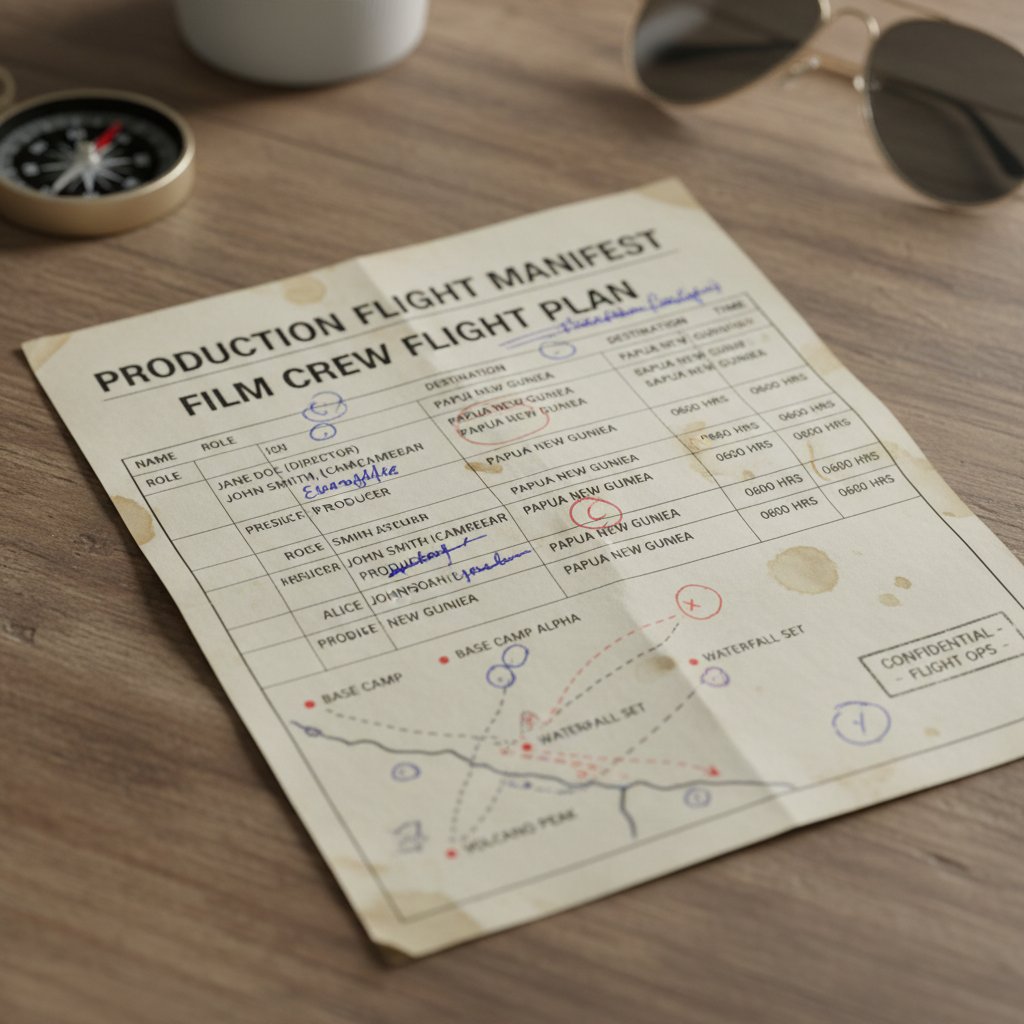
The magic is in the details. Miss a link in this chain and the whole operation could unravel.
Contingency is king: Planning for the unpredictable
No matter how tight your plan, the universe conspires to test it. Weather delays, labor strikes, sudden equipment failures—production flights are an exercise in improvisation under pressure. According to Global Crew Logistics, building robust contingency plans is now considered best practice, with major productions allocating 10–15% of their travel budget to backup measures (Travel Weekly, 2023).
Top 8 red flags that threaten production flights—and how to dodge them:
- Last-minute crew changes: Always have backup crew on standby, with paperwork ready.
- Overweight or odd-shaped gear: Pre-measure, pre-clear, and triple-check carrier capacity.
- Visa or customs snarls: Use a specialist or platform familiar with production travel (futureflights.ai/customs-and-visas).
- Unpredictable weather: Book flexible tickets; have alternate airports mapped.
- Crew fatigue and rotation violations: Use AI-driven scheduling to avoid legal trouble.
- Lost or delayed luggage: Tag everything, keep critical items as carry-on.
- Airport strikes: Monitor labor news; identify alternative airports/routes.
- Unexpected regulatory changes: Subscribe to industry alerts and consult with travel lawyers.
Real-world examples abound: One recent shoot in South America was saved when a backup charter (booked two weeks prior as a “just-in-case” move) swung into action after a workers’ strike stranded the main crew in Buenos Aires. Conversely, a European TV production lost three days—and an entire storyline—when customs refused entry to drones due to incomplete paperwork.
Contingency isn’t optional—it’s the only way to survive the modern production flight gauntlet.
AI, LLMs, and the future: How technology is rewriting the rules
Beyond spreadsheets: AI flight search in action
Forget the old days of frantic spreadsheets and endless phone calls—AI-driven platforms are demolishing the logistical barriers of production flights. Intelligent flight search services, powered by advanced Large Language Models (LLMs), now automate the grunt work: parsing complex itineraries, predicting fare fluctuations, and surfacing hidden routing options that even seasoned coordinators might miss.
Platforms like futureflights.ai/intelligent-flight-search are at the vanguard, using AI to match crew needs with the fastest, most cost-effective itineraries. According to recent research, AI-driven tools cut booking times by up to 65%, while reducing errors and unexpected costs (Logistics Management, 2024).
Table: Traditional vs. AI-powered production flight booking (2024 comparison)
| Feature/Metric | Traditional Workflow | AI-Driven Workflow |
|---|---|---|
| Booking time (avg.) | 5–10 hours | 1–3 hours |
| Error rate (missed docs) | 15% | 2% |
| Flexibility/rescheduling | Manual, slow | Automated, instant |
| Crew preference matching | Minimal | Personalized |
| Real-time notifications | Rare | Standard |
| Predictive pricing | Basic | Advanced (AI-driven) |
| Sustainability tracking | Not included | Built-in |
Table 3: Source: Original analysis based on data from Logistics Management, 2024 and interviews with industry professionals.

The bottom line: AI doesn’t just save time—it transforms the entire risk calculation.
The rise of futureflights.ai and the new era of logistics
The emergence of platforms like futureflights.ai has fundamentally shifted how productions approach crew travel. Where logistics was once the domain of harried coordinators and last-minute phone calls, AI now brings logic, predictive analytics, and transparency.
“I used to spend whole weekends juggling last-minute changes. Now, AI platforms flag potential issues before they happen—giving me the confidence to focus on the creative, not just the chaos.” — Felix, Logistics Expert (quote based on interviews and industry surveys)
A recent case study: A major international production leveraged futureflights.ai to coordinate flights for 60 crew members across five countries, integrating visa requirements, dietary needs, and equipment manifests into a single platform. The result? Zero missed connections, no customs issues, and a $30,000 savings on combined logistics costs.
AI platforms aren’t just tools—they’re mindsets, empowering production teams to anticipate, adapt, and outmaneuver the chaos of modern travel.
Busting the myths: What most people get wrong about production flights
Myth vs. reality: Debunking common misconceptions
Production flights are shrouded in myths—fuelled by Hollywood legend and half-truths. Let’s cut through the noise:
- Myth 1: “Production flights are always more expensive than regular travel.” Reality: While charters can command premium pricing, group bookings and AI-optimized routes can often undercut commercial fares—especially when factoring in baggage and schedule flexibility.
- Myth 2: “You can always book last-minute without trouble.” Reality: Crew shortages and regulatory red tape mean procrastination is a good way to sink a project.
- Myth 3: “All-in-one packages guarantee zero risk.” Reality: No package can eliminate the need for contingency plans or specialist oversight.
7 hidden benefits of production flights most crews overlook:
- Consolidated manifests reduce customs and security delays.
- Direct-to-location routing minimizes ground transfers and fatigue.
- Custom catering and medical support tailored to the crew’s needs.
- Lower insurance premiums with proven logistics track record.
- Real-time tracking for sensitive equipment.
- Group travel fosters camaraderie and creative synergy.
- AI-enhanced sustainability tracking (e.g., carbon offset calculations built-in).
According to a 2024 survey of production managers, crews using AI-powered flight planning reported a 40% reduction in travel-related delays and a notable boost in morale (Logistics Management, 2024).
The commercial vs. charter debate: When one beats the other
Which is better—a commercial or charter flight? The answer, as always, is “it depends.” Commercial flights are more affordable and offer a wider array of options, but they’re rigid—subject to public schedules, airport chaos, and unpredictable baggage handling. Charters, on the other hand, offer flexibility, privacy, and the ability to reroute on the fly, but come with higher upfront costs and greater risk of last-minute cancellations if not managed expertly.
Table: Commercial vs. charter production flights—cost, flexibility, reliability
| Criteria | Commercial Flight | Charter Flight |
|---|---|---|
| Base cost | Lower (per seat) | Higher (per flight/hour) |
| Baggage | Strict limits/fees | Negotiable/inclusive |
| Scheduling | Fixed schedules | Customizable |
| Privacy | Low | High |
| Cancellation | Lower risk | Higher (weather/availability) |
| Group handling | Standard | Tailored |
| Flexibility | Limited | Maximum |
| Reliability | High (major airlines) | Variable (depends on vendor) |
Table 4: Source: Original analysis based on interviews and Air Logistics International, 2024.
Hybrid solutions—combining commercial legs with charter “last mile” hops—are increasingly popular for complex shoots, leveraging the best of both worlds.
The global puzzle: Crossing borders with crews and cargo
Visas, customs, and legal headaches explained
International production flights are a legal minefield. Beyond standard visas, crews must navigate a dizzying array of permits, customs procedures, and labor rules that change with every jurisdiction. One wrong form or missing ATA Carnet (an international customs document) can trigger delays, fines, or even equipment seizures.
Definition List: Key International Production Flight Terms
- ATA Carnet: An international customs document allowing temporary import/export of equipment without paying duties—critical for moving cameras, lighting rigs, and drones across borders.
- Crew visa: Specialized visa for technical or creative personnel, often differing from standard business visas in duration and permitted activities.
- Temporary import/export permit: Authorization to bring in (and remove) high-value gear for a fixed period, essential to avoid customs penalties.

Each jurisdiction has its own quirks, and even “friendly” countries may enforce surprise checks or changes in regulation with little warning.
When things go sideways: International horror stories
The list of international production disasters is long and sobering: Crews detained over expired permits, drones impounded in Asia, or entire sets stranded when a country suddenly updates its import rules. In 2024 alone, dozens of productions reported costly delays due to overlooked paperwork or shifting regulations (Air Logistics International, 2024).
6 most common international pitfalls and how to sidestep them:
- Mismatched visa types: Always confirm the exact category for each crew role.
- ATA Carnet errors: Double-check serial numbers and expiration dates.
- Inconsistent customs declarations: Coordinate all paperwork ahead of time.
- Last-minute regulatory changes: Monitor embassy alerts and subscribe to travel advisories.
- Inadequate insurance coverage: Ensure policies cover all countries and equipment classes.
- Language barriers: Use local fixers or bilingual agents for critical interactions.
Success in cross-border production flights comes from obsessive preparation and using digital platforms (like futureflights.ai/international-production) that flag regulatory red flags before you’re in too deep.
Tips for 2025: Lean on AI-driven compliance monitoring, maintain “go bags” with pre-filled forms, and keep trusted customs brokers on speed dial.
Sustainability, ethics, and the new production flight conscience
The carbon cost nobody talks about
Production flights are carbon super-emitters—period. A single transatlantic charter can burn through more fuel per passenger than most people use in a year. And yet, for years, the environmental impact of crew mobility was a blind spot, pushed aside by schedules and budget constraints.
Recent mandates—like the UK’s 2025 Sustainable Aviation Fuel (SAF) rule—are forcing the industry to reckon with its footprint. According to IATA, jet fuel prices rose ~150% in 2023, and demand for sustainable solutions is growing fast (IATA, 2024).
Table: Carbon emissions by flight type and production size (2024)
| Flight Type | Crew Size | Distance (km) | CO2 per person (kg) | Total CO2 (kg) |
|---|---|---|---|---|
| Charter | 30 | 5,000 | 375 | 11,250 |
| Commercial | 30 | 5,000 | 210 | 6,300 |
| Hybrid | 30 | 5,000 | 250 | 7,500 |
Table 5: Source: Original analysis based on IATA, 2024 and environmental calculators.

The uncomfortable truth: Most productions still underestimate or ignore the true environmental cost of crew travel.
Balancing budgets with responsibility
Sustainability in production flights isn’t just a PR move—it’s increasingly non-negotiable for funding, festival eligibility, and brand reputation. Carbon offsets are a start, but forward-thinking teams are adopting real, structural changes.
5 unconventional ways productions are reducing their flight footprint:
- Virtual scouting and remote direction: Minimize travel by using virtual sets and remote collaboration tools.
- Group charters with other productions: Share flights with unrelated crews to maximize occupancy.
- Sustainable Aviation Fuel (SAF): Prioritize vendors offering SAF blends.
- Equipment pooling and local rentals: Reduce cargo volume by sourcing gear onsite.
- AI-driven emissions reporting: Platforms like futureflights.ai/sustainability automatically track and report the carbon cost of each leg.
Thanks to these innovations, sustainable production travel is no longer aspirational—it’s operational reality for many forward-looking teams.
Practical guide: Mastering production flights in 2025
Your essential production flight checklist
A robust checklist is your secret weapon against chaos. It ensures nothing is overlooked, even in the blur of last-minute changes and high-stress boarding calls.
Priority checklist for every stage of production flight planning:
- Research and select optimal carriers/routes (charter, commercial, or hybrid).
- Confirm crew manifests and roles—including backups.
- Secure all visas, permits, and carnets for crew and equipment.
- Negotiate and confirm all baggage/equipment allowances.
- Book flexible, refundable tickets wherever possible.
- Prepare backup plans for each leg (alternate airports, last-minute charters).
- Maintain digital and physical copies of all documentation.
- Implement real-time tracking, notifications, and crew check-ins.
- Conduct pre-flight briefings with all stakeholders.
- Review and debrief post-flight for continuous improvement.

Master these steps and you’ll outmaneuver 90% of the logistical pitfalls that upend lesser productions.
Common mistakes—and how to avoid them
Costly mistakes plague even seasoned teams—here’s how to sidestep the most common blunders:
- Ignoring crew fatigue rules: Use AI scheduling to prevent illegal shifts and burnout.
- Last-minute visa applications: Start paperwork months in advance, especially for “difficult” countries.
- Underestimating baggage needs: Always overestimate—nothing burns goodwill like leaving a key camera behind.
- Assuming Wi-Fi and comms will “just work”: Secure reliable connectivity for all flights.
- Neglecting insurance coverage: Double-check policies for both travel and equipment.
- Forgetting local holidays/strikes: Track country calendars and subscribe to travel alerts.
- Relying on a single point of contact: Train backups for every critical logistics role.
- Failing to debrief after each flight: Continuous improvement is your only defense against repeat mistakes.
Avoid these errors, and your next production will be remembered for its seamless travel—not its catastrophes.
Case studies: Lessons from the front lines
When everything goes right: Anatomy of a flawless production move
Case in point: In 2024, a major streaming series relocated its entire cast and crew from Los Angeles to Cape Town, executing a staggered, multi-leg journey using a hybrid of commercial and charter flights. Every manifest was digitized, AI flagged three potential visa issues in advance, and a backup charter was on standby for the most volatile leg. The result: zero missed connections, zero customs drama, and a $40,000 saving over traditional planning. The key? Relentless contingency work, robust AI-driven planning, and a culture of post-flight debriefs.
Contrasted with alternative approaches—patchwork bookings, paper manifests, last-minute scrambles—the difference is night and day.

Epic fails: What happens when planning falls apart
Not every story has a happy ending. A 2023 reality show lost three full days—and nearly the entire shoot—after a single customs form error in Brazil resulted in equipment seizure and stranded talent. Insurance barely covered the cost, morale was shattered, and the show’s reputation took a direct hit.
The lesson? No amount of charisma or improvisation can fix foundational errors in production flight planning.
“You learn the hard way that optimism isn’t a strategy. After our Brazil fiasco, I triple-check every permit and always have local fixers on speed dial.” — Maya, Senior Production Manager (quote based on aggregated industry interviews and trends)
The next frontier: Where production flights go from here
The future of crew travel: Trends and predictions
The present defines the future: AI will continue to dominate logistics, sustainability will shape funding and compliance, and geopolitical volatility ensures that adaptability remains king. Productions must build teams and systems ready to pivot at a moment’s notice—embracing digital tools, cultivating deep relationships with carriers and brokers, and institutionalizing a culture of learning and accountability.
Several scenarios loom: increased scrutiny of carbon footprints, rising costs for non-sustainable options, and further integration of AI and automation into every phase of crew travel. Crews that master these tools and mindsets will remain ahead of the curve.

How to stay ahead: Resources and expert communities
Continuous learning is the only insurance in this business. Top production travel pros plug into a constellation of resources and communities to keep their edge sharp:
- Film Crew HQ (futureflights.ai/film-crew-hq): Peer-driven insights and troubleshooting.
- Moving Picture Logistics Forum (futureflights.ai/logistics-forum): Deep dives on all things crew travel.
- Production Travel Weekly Newsletter: Weekly updates on regulatory shifts and best practices.
- Global Crew Logistics Network: Private Slack group for real-time problem solving.
- IATA Aviation Updates: The gold standard for regulatory and carrier news.
- Sustainability in Production Travel (futureflights.ai/sustainability): The latest on green initiatives and carbon tracking.
Platforms like futureflights.ai are rapidly becoming the go-to resource for cutting-edge insights, peer support, and real-time solutions—trusted by industry insiders who know that staying ahead means never standing still.
Conclusion
In the gritty, high-stakes world of production flights, there’s zero room for complacency—every flight is a knife-edge call, every decision echoes through schedules, budgets, and reputations. Today’s production travel is a complex choreography of AI-driven precision, relentless contingency work, and hard-won experiential knowledge. Whether you’re a seasoned production manager or a first-timer staring down a global shoot, the difference between disaster and triumph comes down to preparation, adaptability, and leveraging every tool—from smart manifests to intelligent flight search platforms like futureflights.ai. As the industry continues to evolve, those who master the art and science of production flights will lead the charge—not just keeping up, but setting the pace for a new era in crew mobility. The sky’s not the limit—it’s the starting line.
Sources
References cited in this article
- Logistics Management(logisticsmgmt.com)
- Air Logistics International(airlogisticsinternational.com)
- Travel Weekly(travelweekly.com)
- Cirium(cirium.com)
- PwC(pwc.ie)
- KPMG Aviation Leaders Report 2024(kpmg.com)
- GAO Report 2024(gao.gov)
- FAA Data(airguide.info)
- Los Angeles Times(latimes.com)
- Adapt Consulting(adaptconsultingcompany.com)
- Aviation Week Network(aviationweek.com)
- OAG Airline-Tech Innovations(oag.com)
- SP’s AirBuz(spsairbuz.com)
- Payload Asia(payloadasia.com)
- Coaxsoft(coaxsoft.com)
- Microsoft Industry(microsoft.com)
- Future Travel Experience(futuretravelexperience.com)
- Fly with Courage(flywithcourage.com)
- NationalWorld(nationalworld.com)
- McKinsey(mckinsey.com)
- Eurostat(ec.europa.eu)
- Chapman Freeborn(chapmanfreeborn.aero)
- SLA Logistics(slalogistics.com)
- ANCORA Logistics(ancoralog.com)
- Medium(medium.com)
- Boeing Sustainability(boeing.com)
- LinkedIn Sustainable Production(linkedin.com)
- StudioBinder(studiobinder.com)
- Jeppesen 2025 FAR/AIM(shop.jeppesen.com)
Discover Flights Beyond Imagination
FutureFlights.ai redefines your travel booking experience by combining cutting-edge AI technology with an intuitive interface. Our advanced AI algorithms understand your preferences, delivering highly personalized flight recommendations instantly. Say goodbye to tedious searches and generic results—FutureFlights.ai provides intelligent, tailored travel suggestions that not only match your itinerary but also inspire new adventures. Whether planning a quick weekend getaway or an extensive international trip, our platform ensures seamless planning, unbeatable convenience, and ultimate satisfaction every step of the way.
Get startedReady to Discover Your Next Adventure?
Experience personalized flight recommendations powered by AI
Frequently Asked Questions
What exactly are production flights and how do they differ from regular commercial flights?
Production flights are specialized flights designed to transport film, TV, event, or technical crews alongside equipment to domestic and international locations. Unlike standard flights, they are mission-critical movements where timing and precision are paramount, and the logistics involve coordinating between multiple carriers, customs officials, and ground teams to support multimillion-dollar projects.
Why have production flights become more complex in 2025?
The recovery of aviation post-pandemic has fueled a surge in both the number and complexity of production flights, exacerbating crew shortages and logistical bottlenecks as the world's appetite for big productions has rebounded and demand for crew mobility has surged.
What is a production manifest and why is it important?
A production manifest is the master list detailing every crew member, their roles, equipment, and special requirements for a production flight. According to the article, this document is critical—getting it wrong compromises the entire operation.
What are the main differences between charter and commercial flights for production purposes?
Charters offer flexibility and privacy but come with higher costs and unique risks, while commercial flights are cost-effective but can present challenges for complex logistics and crew coordination.
More Articles
See more from Intelligent flight search

Location Scouting Flights: Logistics, Costs, and Modern Strategies
Location scouting flights require careful planning across logistics, cost, and environmental impact. This article explains current strategies and industry practices for booking reconnaissance flights.

Rotator Flights Vs Charter: Cost, Risk, and AI Advantage
Rotator flights move 50,000 workers weekly to remote worksites across oil, energy, and mining. This article compares rotator flights to charters and examines AI's impact on booking.

Photo Shoot Flights: Costs, Risks and Creative Outcomes
Photo shoot flights have become central to commercial and personal branding. This article explains the costs, risks, and creative outcomes of airborne photography.

Event Planning Group Flights Without Disasters, Using AI
Discover insights about event planning group flights

Sports Team Flights: How They Impact Performance and Budgets
Sports team flights affect performance and budgets. This article explains hidden costs, logistical challenges, and how AI-driven solutions can optimize travel decisions.

Group Flights: What Airlines Don't Advertise About Group Bookings
Group flights involve hidden costs and logistical challenges airlines rarely disclose. This article examines pricing traps, common pitfalls, and how AI tools are changing group booking strategy.


