


Budget-Friendly Flight Search When Algorithms Rig the Price
Written with AI assistance under our editorial guidelines
Modern flight search results are manipulated by commercial agreements and ranking algorithms that prioritize affiliate fees over genuine savings. Airlines use sophisticated dynamic pricing systems, while search platforms funnel users toward predetermined results. Success requires understanding these psychological traps, recognizing algorithmic biases, and leveraging AI tools strategically to navigate the opaque system.
Forget everything you thought you knew about cheap flights. The game has changed, the rules have shifted, and if you’re still clinging to old-school budget travel hacks, you’re bleeding money every time you hit “search.” In 2025, budget-friendly flight search is a brutal contest between wily algorithms, airline overlords, and travelers armed with AI-powered tools. It’s not just about knowing when to book or which site seems legit. The real winners are those who see through the smokescreen—who recognize the psychological traps, dodge the algorithmic bullets, and wield new-gen tech like a scalpel, not a club. This isn’t a gentle guide for the faint-hearted. It’s a manifesto for those ready to stare down the airfare matrix, sidestep the clickbait, and finally, for once, come out on top. Welcome to the new rules of budget-friendly flight search—where myth meets reality and only the sharp survive.
Why budget-friendly flight search is broken—and who profits
The illusion of choice in modern airfare
Every time you punch your city pairs into a flight search engine, you’re hit with a wall of options. Hundreds of flights, dozens of airlines, and endless price points—it looks like freedom, but the reality is a carefully curated illusion. According to an in-depth analysis by Ideal Magazine, 2024, most online travel agencies and meta-search tools funnel users toward a narrow band of results. These are shaped less by genuine price competition, and more by opaque commercial agreements and manipulative ranking algorithms.
Image: Flight search results blending together on a traveler’s screen.

It’s not only that similar flights are repeated across platforms—it’s that the “best deal” is often defined by whoever paid the highest affiliate fee. While it feels empowering to browse for hours, the deck is stacked. Your so-called choices are filtered by hidden priorities you never signed up for. This is the first lesson: in the world of budget-friendly flight search, transparency is scarce, and your sense of control is, more often than not, just another product on sale.
Who really sets the prices: airlines vs algorithms
Price tags on flights are not set in stone—they’re alive, pulsing with data and shaped by a shadowy tug-of-war between airline revenue managers and third-party search engines. Airlines wield sophisticated “revenue management systems” to adjust fares in real time, responding to demand, seasonality, and competitor moves. Overlaying this, search engines introduce their own algorithms, sometimes marking up, sometimes discounting, always chasing their own margin. According to Mighty Travels, 2024, aggregators and emerging AI search tools now play an outsized role in what you actually pay.
| Factor | Airline Revenue Manager | Third-Party Aggregator | AI Search Engine |
|---|---|---|---|
| Base fare setting | Yes | No | No |
| Real-time price shifts | Yes | Yes | Yes |
| Personalized offers | Moderate | High | High |
| Dynamic pricing | Yes | Yes | Yes |
| Affiliate commissions | No | Yes | Sometimes |
Table 1: Comparison of factors influencing airfare—airline, aggregator, and AI engine roles.
Source: Original analysis based on Mighty Travels, 2024, Ideal Magazine, 2024
The result? Prices for the same seat can fluctuate by hundreds of dollars depending on how, when, and where you search—even if you’re seconds apart on different devices.
The psychological traps airlines set
It’s not just numbers on a screen—it’s a psychological assault. Airlines and booking engines bake in urgency messaging ("Only 2 seats left at this price!"), flash sales with ticking clocks, and subtle reminders of “what you might lose.” According to travel industry analyst Alex (as cited in Matt’s Flights Guide, 2024), these tactics aren’t innocent. They’re designed to trigger your FOMO, cloud your judgement, and push you toward impulsive decisions.
"It’s not just about price—it’s about manipulating your panic."
— Industry analyst Alex, Matt’s Flights Guide, 2024
Dynamic pricing ensures that your hesitation becomes costly—refresh the page, and the price climbs. Your search history is weaponized to track intent, making you a target for strategic upcharges. In the battleground of cheap flights, the house always tries to win—but only if you play by their rules.
The evolution: from travel agents to AI-powered flight search
A brief history of flight search technology
How did we get here? The journey from brick-and-mortar travel agencies to today’s ultra-connected, AI-fueled search engines is a story of tech disruption, consumer empowerment—and a little bit of chaos. In the 1980s, travelers relied on trusted agents; fares were fixed, options few. By the mid-1990s, the first online booking portals appeared, democratizing access but also opening the door to information overload.
Timeline: Key milestones in flight search evolution (1980s–2025)
- 1980s: Computerized Reservation Systems (CRS) debut in travel agencies, digitizing inventory.
- Late 1990s: Online booking portals (Expedia, Travelocity) go mainstream.
- Early 2000s: Aggregators (Kayak, Skyscanner) centralize flight data.
- 2010s: Mobile apps and price-alert tools proliferate, increasing transparency and user agency.
- 2020s: AI and LLM-powered search engines (like futureflights.ai) introduce real-time personalization and advanced fare prediction.
This progression isn’t just about convenience. It’s a shift in power—from gatekeeping agencies, to the algorithmic wild west, to a new era where artificial intelligence knows your preferences better than you do.
How AI and LLMs are rewriting the rules
AI-driven flight search engines have fundamentally changed how we find, compare, and book flights. Instead of scanning hundreds of results manually, AI parses your search intent, learns your budget, and generates tailored recommendations in seconds. Recent research from Reddit’s flight deals community, 2024 highlights how platforms leveraging large language models (LLMs) can identify hidden patterns in historical airfare data—surfacing deals that human travelers would otherwise miss.
Image: AI algorithm visualizing optimal flight paths.

This isn’t just a leap in technology—it’s a seismic power shift. AI can bypass marketing manipulation, cut through sponsored results, and highlight truly budget-friendly flight search opportunities, provided you know how to use it.
Case study: A week in the life of a flight search addict
Meet Lara—part obsessive, part methodical, an archetype of the modern budget traveler. Over seven days, she stalks airfares for a single route (New York to Berlin), recording prices across platforms and times. Her findings reveal a rollercoaster of manipulation: prices spike on weekends, dip midweek, and surge after repeated searches from the same IP.
| Day | Search Platform | Lowest Fare | Notes |
|---|---|---|---|
| Monday | Airline Direct | $420 | High, little variation |
| Tuesday | Aggregator | $390 | Flash sale dropped price |
| Wednesday | Skiplagged | $375 | Hidden-city fare available |
| Thursday | Reddit (Deals) | $360 | Found mistake fare alert |
| Friday | Google Flights | $410 | Price rebounded |
| Saturday | Incognito Mode | $420 | No meaningful difference |
| Sunday | Futureflights.ai | $370 | Personalized AI recommendation |
Table 2: Day-by-day log of flight prices for NY–Berlin, real user experience.
Source: Original analysis based on user tracking and Reddit’s flight deals community, 2024
Notice the volatility—and the fact that no single day or method “wins” every time. The real advantage comes from flexibility, multi-platform comparison, and leveraging AI-driven recommendations.
Myth-busting: what most travelers get wrong about cheap flights
Is Tuesday really the cheapest day to book?
The legend persists: “Book on Tuesday for the lowest fares.” But the airline industry has outgrown this myth. According to a deep-dive by Ideal Magazine, 2024, fare fluctuations are now powered by algorithms that track demand in real time, not by arbitrary days of the week.
"The Tuesday trick is dead—algorithms don’t care what day it is," warns data scientist Jamie. — Data scientist Jamie, Ideal Magazine, 2024
Booking midweek can sometimes save you money, but there’s no universal rule. The real hack is flexibility: shift your departure by a day or two, compare multiple dates, and watch prices drop.
Do incognito browsers actually help?
There’s a persistent belief that searching flights in incognito or private mode hides you from price hikes. But the science is murky. Research from Matt’s Flights Guide, 2024 and technical analyses confirm that most price changes are driven by demand spikes and inventory, not cookies or browser history. However, some platforms do use cookies to nudge you back to higher fares if you hesitate.
Common myths about search privacy—and what actually works:
- Myth: Incognito mode guarantees lower fares.
- Reality: It may prevent some persistent tracking, but dynamic pricing is based mostly on demand and seat availability.
- Myth: Clearing cookies resets prices.
- Reality: Impact is minimal; inventory and demand shifts are far more influential.
- Myth: Switching devices helps.
- Reality: Occasionally true if sites aggressively use device fingerprinting, but not a consistent hack.
- What actually works: Use fare prediction tools, compare platforms, and watch for flash sales.
Hidden fees: the silent budget killer
Think you’ve found a $50 ticket? Brace yourself for the aftershock: baggage fees, seat selection, payment surcharges, and even mysterious “processing” charges. According to Mighty Travels, 2024, hidden fees inflate the real cost of a ticket by an average of 25–40%—particularly on budget carriers.
| Airline | Carry-on Bag | Checked Bag | Seat Selection | Meal Fee | Payment Fee |
|---|---|---|---|---|---|
| Major Legacy | $0–$40 | $25–$60 | $0–$30 | $0–$20 | $0–$10 |
| Low-cost Carrier A | $20–$40 | $30–$70 | $10–$25 | $10–$30 | $5–$15 |
| Low-cost Carrier B | $15–$35 | $35–$60 | $15–$25 | $5–$15 | $5–$10 |
Table 3: Feature matrix of common hidden fees across major airlines.
Source: Original analysis based on Mighty Travels, 2024
If you’re serious about budget-friendly flight search, read the fine print—and factor total cost, not just the sticker price.
Inside the machine: how flight search engines really work
Meet the algorithms: dynamic pricing explained
Every fare you see is a living, breathing number—fluctuating with demand, time, and your own behavior. Airlines deploy complex dynamic pricing algorithms that monitor real-time searches, booking velocity, and market trends. According to Matt’s Flights Guide, 2024, predictive analytics now drive most fare adjustments, creating a market where prices can change dozens of times per day for the same seat.
Image: Dynamic pricing algorithm adjusting airfare in real time.
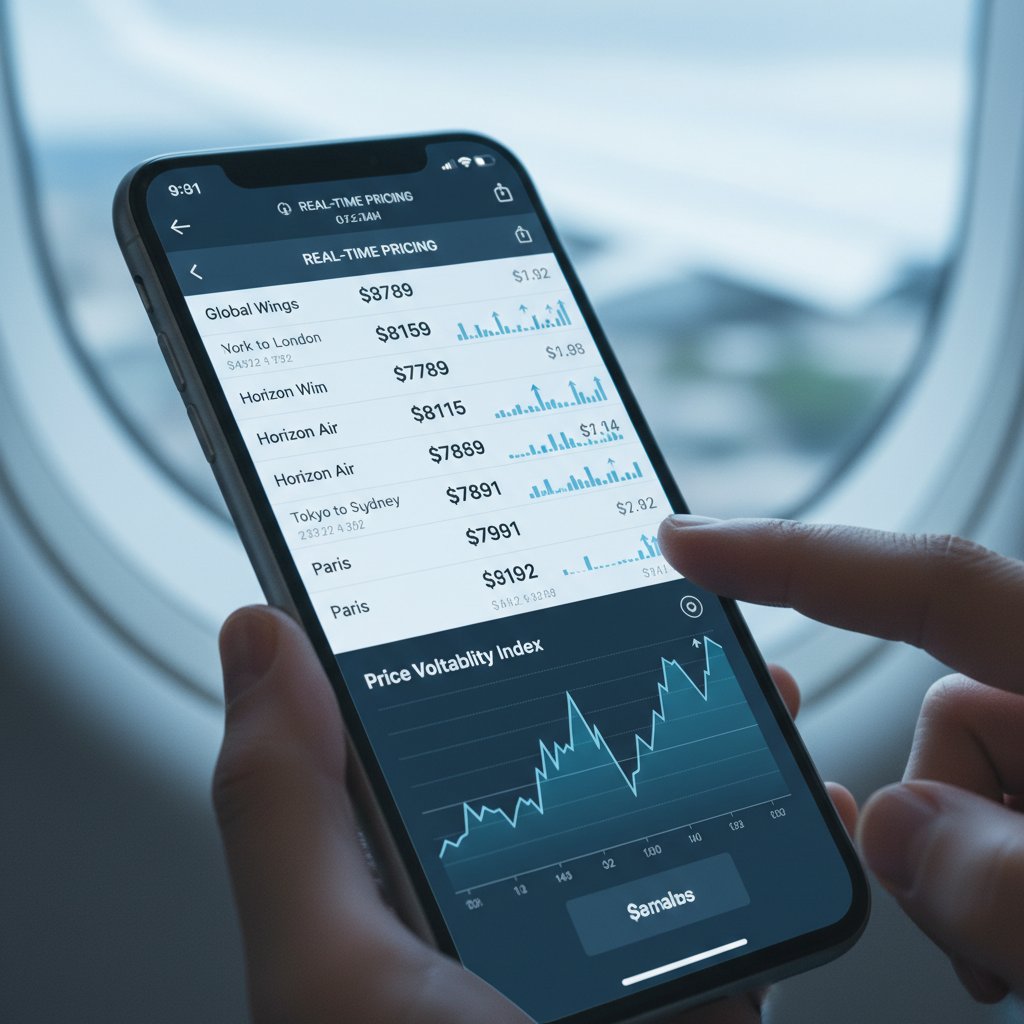
If you notice a fare creeping up after multiple searches, it’s not paranoia—the system is engineered to capitalize on indecision and perceived urgency.
What your data reveals (and how it’s used against you)
Every click, every search, every abandoned cart—it’s all data, and it’s all for sale. Flight search engines harvest behavioral patterns: your typical travel dates, preferred destinations, and even how long you hesitate before booking. This information feeds personalization engines that can either present tailored deals or, just as often, push pricier options your way.
Key terms in algorithmic airfare:
A pricing strategy where fares fluctuate in real time based on demand, inventory, and competitive analysis.
The process of tailoring flight offers and search results to individual user profiles and behaviors. Can deliver real savings—or manipulate you into spending more.
Advanced data modeling that anticipates future price movements, helping both airlines maximize revenue and savvy travelers lock in lower fares.
Understanding these terms isn’t just nerd trivia—it’s your only defense against becoming another victim of the airfare matrix.
The rise of futureflights.ai and next-gen search tools
In a landscape crowded with me-too aggregators, next-gen AI platforms like futureflights.ai are changing the game. By leveraging large language models and real-time data, these tools cut through the noise, offering truly personalized, budget-friendly flight search recommendations that anticipate your needs and adapt on the fly.
Image: Cutting-edge AI flight search interface.

Rather than endlessly scrolling through generic results, users get context-aware suggestions and predictive alerts—making old-school price comparison look positively archaic.
Strategies the pros use (and airlines hope you never learn)
Advanced fare prediction hacks
True budget ninjas don’t just compare prices—they predict them. Modern fare prediction tools, powered by AI, analyze millions of historical data points to forecast when prices will rise or fall. According to Matt’s Flights Guide, 2024, using these tools can save travelers an average of 15–20% on major routes.
Step-by-step guide to mastering budget-friendly flight search using AI tools:
- Set price alerts early: Use platforms like Google Flights or futureflights.ai to track your route for weeks—not days—before booking.
- Compare multiple platforms: Don’t trust a single aggregator; cross-reference at least three, including AI-driven options.
- Leverage historical data: Look for tools that incorporate previous fare trends and not just live prices.
- Monitor flash sales and mistake fares: Join communities like Skiplagged and Reddit’s r/flightdeals to find time-sensitive opportunities.
- Be flexible with dates and airports: A shift of even 24 hours or a different arrival city can yield triple-digit savings.
Booking windows: when to strike for the lowest fares
The optimal booking window is a moving target, but recent industry studies analyzed in Mighty Travels, 2024 suggest the sweet spot is 2–3 months before domestic departures and up to 4–6 months for international routes. Booking last-minute usually triggers price hikes; airlines know desperate travelers will pay.
However, exceptions exist: budget airlines sometimes release “fire sale” seats a few days before departure, but these are rare and risky. For most travelers, patience and planning trump impulse and urgency.
The truth about error fares and hidden city ticketing
Error fares—those legendary $50 transatlantic flights—do exist, but they’re rare, volatile, and often canceled. Skiplagged’s infamous “hidden city” ticketing (booking a flight with a layover in your real destination) can yield savings, but carries real risks: missed connections, canceled return legs, and the wrath of airlines.
"If you play with hidden city tricks, be prepared for fallout," notes travel hacker Priya. — Travel hacker Priya, Reddit Flight Deal Strategies, 2024
Use with caution—and know the consequences before you outsmart the system.
Red flags and risks: what could go wrong in your search for cheap flights
Spotting scam sites and fake deals
The darker side of the budget quest: scam sites and too-good-to-be-true deals. According to Ideal Magazine, 2024, the proliferation of discount portals has led to a surge in fake fares and phishing attempts—preying on the desperation of bargain hunters.
Red flags when searching for cheap flights:
- No physical address or contact info: Legit portals always provide verifiable contact details.
- Unusual payment methods: Demands for wire transfers, cryptocurrency, or prepaid cards are a major warning sign.
- Poor website security: Lack of HTTPS or suspicious pop-ups signal danger.
- Deals that demand immediate action: Urgency is a favorite tool of scammers, not just airlines.
- Lack of reviews or third-party validation: Always cross-reference with trusted sources.
When dynamic pricing backfires
Dynamic pricing isn’t infallible—it sometimes creates horror stories. Travelers report fares doubling in minutes, or watching flights vanish after hours of indecision. According to Matt’s Flights Guide, 2024, the safest way to avoid price surges is to set alerts, be ready to book when the time is right, and avoid searching the same route repeatedly from the same device.
Locking in fares with refundable or flexible tickets can also hedge against sudden spikes.
The privacy cost of 'personalized' offers
Personalized search can deliver killer deals—or cost you more than you save. Every preference you share, every route you track, becomes part of a digital profile that can be used to tweak prices in your favor or against you.
| Factor | Personalized Search | Anonymous Search |
|---|---|---|
| Tailored recommendations | Yes | No |
| Targeted deals | Yes | No |
| Potential higher prices | Sometimes | Rare |
| Data privacy risk | High | Low |
| Booking convenience | High | Low |
Table 4: Cost-benefit analysis of personalized vs. anonymous flight search.
Source: Original analysis based on Matt’s Flights Guide, 2024, Ideal Magazine, 2024
Ultimately, the choice is yours: convenience and savings, or privacy and control.
The future is now: how AI and LLMs are changing flight search forever
Personalized recommendations: blessing or curse?
There’s a seductive power in hyper-personalized flight suggestions. AI not only predicts what you want—it can inspire entirely new journeys, surfacing routes and deals you’d never discover on your own. Yet, as recent research from Mighty Travels, 2024 highlights, personalization can also blind you to outlier deals outside your “profile.”
Image: AI assistant recommending flights to a traveler.

It’s a balancing act: let AI sweat the details, but never stop cross-referencing with manual checks.
The ethics of algorithmic airfare
With great power comes great controversy. As AI-driven pricing becomes the norm, debates over fairness, transparency, and access are heating up. According to a recent industry report, regulators are increasingly scrutinizing algorithmic opacity, demanding clearer disclosure of how fares are set and who profits. Consumer advocacy groups argue for algorithmic “explainability”—the right to know why you’re seeing a particular fare.
Airlines and platforms must now walk a tightrope between maximizing profits and ensuring that price discrimination doesn’t cross into outright exploitation.
What’s next: predictive travel planning and beyond
The next frontier isn’t just about finding a cheap seat—it’s about predictive, context-aware travel planning. Think AI that bundles flights, hotels, and ground transport into ultra-personalized itineraries based on your real-world needs and constraints.
Emerging terms in AI flight search:
Artificial intelligence that adapts flight suggestions in real time based on your current context: location, budget, and even weather disruptions.
Combining multiple travel elements—flights, hotels, transfers—into dynamic, personalized packages, priced and assembled automatically.
Fare models that shift not just with demand, but with user behavior, trip history, and external data.
The future isn’t speculation—it’s already arrived for those bold enough to leverage these tools.
Real stories: wins, losses, and lessons from the field
How Mia saved $500 with a smart search strategy
Mia, a self-professed travel geek, combined fare prediction tools, price alerts, and flexible routing to slash $500 off her New York–Bangkok ticket. By tracking fares for two months, using futureflights.ai to compare alternative airports, and pouncing on a flash sale she spotted on Reddit’s r/flightdeals, she outmaneuvered both airlines and search engines.
Image: Traveler celebrating an affordable flight booking.

Her advice: “Don’t get emotionally attached to one date or route—let the data lead you to the deal.”
Sam’s near-miss: when a bot almost cost him his vacation
Not all stories end with a bargain. Sam set an aggressive auto-booking bot to snap up a cheap fare, only to discover it had locked in a nonrefundable ticket for the wrong dates. The airline’s customer service was unsympathetic, and he spent days untangling the mess.
The lesson? Automation is a tool, not a substitute for vigilance. Always double-check every detail before you commit.
User checklist: are you overpaying for flights?
Before you click “book,” run through this priority checklist to ensure you’re not leaving money on the table:
- Compare prices across at least three platforms, including AI-powered search.
- Set fare alerts and monitor price trends for at least two weeks, if possible.
- Check alternative airports and flexible routing options.
- Review all fees—baggage, seat, payment—before finalizing.
- Use incognito mode only as a backup measure, not your main strategy.
- Leverage fare prediction data, not just live prices.
- Validate all booking sites for legitimacy and security.
- Read cancellation and change policies carefully.
- Beware of hidden city or error fare hacks—know the risks.
- Keep screenshots and confirmation emails for every step.
Actionable takeaways: your new rules for budget-friendly flight search
Top 10 unconventional uses for budget-friendly flight search
Today’s tools go far beyond basic travel. Here’s how to bend them to your will:
- Last-minute business hops: Use AI fare prediction to optimize emergency bookings, trimming corporate travel costs.
- Surprise destination weekends: Let personalized suggestions pick a city based on your mood and budget.
- Multi-city adventures: Plan complex itineraries (e.g., digital nomad circuits) with intelligent route assembly.
- Hidden gem scouting: Find off-the-radar airports and obscure carriers for unique experiences.
- Gap year planning: Map entire months of flexible travel with price tracking and fare prediction.
- Family reunions: Coordinate group fares and varied departure points seamlessly.
- Event-based bookings: Snipe festival or sports event flights before demand surges.
- Educational trips: Organize student exchanges or field studies with cost-effective, scalable booking.
- Medical travel: Identify affordable, multi-leg routes for necessary treatment abroad.
- Bucket list blitz: Use predictive tools to sequence multiple dream destinations at the lowest combined price.
The bottom line: what really matters (and what doesn’t)
If you’ve made it this far, you already know—the old playbook is dead. Budget-friendly flight search is no longer about gut instinct or outdated “best day to book” tips. It’s a high-stakes, high-tech arena, where only those who understand the real mechanics—algorithmic manipulation, psychological tactics, AI-driven prediction—can consistently win.
The new rules are simple, but not easy: Be flexible, let data guide you, cross-check every offer, and never stop questioning the system’s motives. If you’re ready to challenge the status quo, wield modern tools smartly, and keep your wits about you, the rewards are real—and so are the savings.
Budget-friendly flight search isn’t about luck. It’s about strategy, vigilance, and the courage to see through the illusion. The system is rigged; your job is to outsmart it. Now go make your next trip a win.
Sources
References cited in this article
- Matt’s Flights Guide(mattsflights.com)
- Mighty Travels: 8 Insider Tips(mightytravels.com)
- Ideal Magazine: Myths & Secrets(idealmagazine.co.uk)
- Reddit Flight Deal Strategies(mightytravels.com)
- Mighty Travels: Flight Search Engines(mightytravels.com)
- Allied Market Research: Low Cost Airlines(alliedmarketresearch.com)
- PwC 2024 Aviation Outlook(pwc.ie)
- PIRG Plane Truth 2024(pirg.org)
- Enterprise Apps Today: Airline Stats(enterpriseappstoday.com)
- OAG: 2024 Airfare Insights(oag.com)
- Forbes: AI in Travel(forbes.com)
- Market.us: AI in Travel Market(market.us)
- NYT: Airlines & AI(nytimes.com)
- NASA: Flight Advances(nasa.gov)
- Smithsonian: Milestones of Flight(airandspace.si.edu)
- Britannica: History of Flight(britannica.com)
- Expedia 2025 Travel Hacks(timeout.com)
- Thrifty Traveler(thriftytraveler.com)
- Travel + Leisure(travelandleisure.com)
- USA Today: Best Day to Book(usatoday.com)
- Travel Noire(travelnoire.com)
- Forbes Advisor(forbes.com)
- Passport Photo Online: Hidden Airline Fees(passport-photo.online)
- Newsweek: Airline Fees(newsweek.com)
- Federal Register: Fee Transparency(federalregister.gov)
- TI Infotech: Technical Overview(blog.tiinfotech.com)
- Smashing Magazine: UX Case Study(smashingmagazine.com)
- Zoromia: Expert Strategies(zoromia.com)
- USA Today: New Strategies(usatoday.com)
- CNBC: Airfare Trends(cnbc.com)
- Investopedia: Booking Windows(investopedia.com)
- Haas Berkeley: Dynamic Pricing Study(faculty.haas.berkeley.edu)
- Nasdaq: Airfare Predictions(nasdaq.com)
- Fetcherr: AI Pricing(fetcherr.io)
- Sciative: Personalized Pricing(sciative.com)
- Enzuzo: Data Privacy Stats(enzuzo.com)
- Exploding Topics: Personalization Stats(explodingtopics.com)
- Platformaeronaut: AI/LLM Impact(platformaeronaut.com)
- MindTitan: AI in Aviation(mindtitan.com)
- PROS: AI Search Engines(pros.com)
- Expedia Q2 2024 Trends(partner.expediagroup.com)
- Forbes: 2024 Travel Trends(forbes.com)
- OAG: Air Travel Statistics(oag.com)
Discover Flights Beyond Imagination
FutureFlights.ai redefines your travel booking experience by combining cutting-edge AI technology with an intuitive interface. Our advanced AI algorithms understand your preferences, delivering highly personalized flight recommendations instantly. Say goodbye to tedious searches and generic results—FutureFlights.ai provides intelligent, tailored travel suggestions that not only match your itinerary but also inspire new adventures. Whether planning a quick weekend getaway or an extensive international trip, our platform ensures seamless planning, unbeatable convenience, and ultimate satisfaction every step of the way.
Get startedReady to Discover Your Next Adventure?
Experience personalized flight recommendations powered by AI
Frequently Asked Questions
Why does budget-friendly flight search feel like it offers many choices when it actually doesn't?
According to the article, online travel agencies and meta-search tools funnel users toward a narrow band of results shaped by opaque commercial agreements and manipulative ranking algorithms rather than genuine price competition. The 'best deal' is often defined by whoever paid the highest affiliate fee, making your sense of choice an illusion.
Who controls flight prices in 2025?
Flight prices are determined by a tug-of-war between airline revenue management systems that adjust fares in real time based on demand, seasonality, and competitor moves, and third-party search engines that use their own algorithms to rank and present options to travelers.
What is the key difference between old-school flight booking methods and modern budget travel strategies?
The article states that old-school budget travel hacks are no longer effective, and instead, the real winners in 2025 are those armed with AI-powered tools who recognize psychological traps, understand how algorithms work, and can see through manipulative ranking systems.
More Articles
See more from Intelligent flight search

How Budget Flight Search Tools Manipulate Airfare Deals
Budget flight search tools employ algorithmic tactics and hidden costs that obscure real deals. This article examines the manipulation behind cheap flight offers and how travelers can navigate them.

How Airline Algorithms Manipulate Flight Prices for Budget Travelers
Budget traveler flight finder tools face new challenges in 2025. This article explains how airline algorithms manipulate fares and which strategies help find genuinely cheap flights.

How Affordable Flights Finder Tools Work Against Airline Pricing
Affordable flights finder tools navigate dynamic pricing and airline strategies. This article explains how airlines set fares and which booking approaches actually reduce costs.

How Airlines Manipulate Budget Flight Search with Dynamic Pricing
Budget flight search exposes how airlines use dynamic pricing and algorithms to manipulate fares. This article explains the mechanics behind inflated costs and cost-saving strategies.

How Airlines Set Low Cost Airfare Prices
Low cost airfare search involves psychological tactics and algorithmic pricing. This article explains how airlines and search engines set prices and what strategies actually reduce fares.

How Budget Airfare Finders Compete with Airline Algorithms
Budget airfare finder tools claim to unlock cheap flights, but modern airline algorithms outmaneuver them.