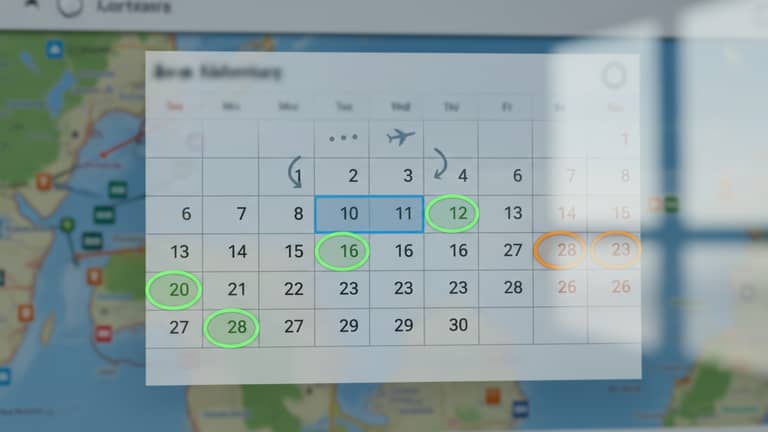
Airfare Calendar Myths That Cost You Money (and What Works Now)
Written with AI assistance under our editorial guidelines
Airfare prices deflated by 2.12% from 2023 to 2024, but dynamic pricing algorithms create the illusion of constant deals and threats, causing decision fatigue and emotional manipulation. Travelers lose money by repeatedly searching and second-guessing rather than booking strategically, while algorithms designed to exploit this behavior keep fares shifting to maximize revenue.
There’s a thrill and a sting when you stare down the airfare calendar: the promise of a cheap escape, the dread of a price spike, the mind games of “what if I wait another hour?” or “did I just get played by an algorithm?” If you’ve ever hunted for flights, you know the feeling—a mix of hope, frustration, and suspicion that someone, somewhere, knows a secret you don’t. The truth is, the airfare calendar is both a tool and a trap. Its grids and graphs lure you with visions of savings, but often leave you wondering if you’re just a pawn in a game rigged by airlines and their relentless algorithms. Buckle up—this isn’t another fluffy guide to scoring cheap flights. We’re tearing apart the myths, hacking through the data, and laying out what it really takes to outsmart the system in 2024. By the end, you’ll know the truth behind dynamic pricing, how AI and LLMs are reshaping flight search, and why most travelers still lose at the airfare calendar game—plus, how to finally start winning. This is the ultimate, research-backed, edgy manifesto for the modern traveler.
Why airfare calendars break travelers’ hearts—and wallets
The emotional rollercoaster of hunting for fares
Flight search is a psychological minefield. Every time you open an airfare calendar, you’re bombarded with shifting prices—green for “cheap,” red for “ouch,” and a kaleidoscope of “maybe-today-is-the-day” mid-range fares. These grids promise control, but in reality, they’re a recipe for second-guessing every decision. According to the U.S. Bureau of Labor Statistics, 2024, airfare prices actually deflated by -2.12% from 2023 to 2024, but try telling that to someone watching their ticket jump $125 after a single refresh. Travelers report feeling manipulated, cheated, even gaslit by shifting fares. It’s not just about money—it’s about trust, regret, and the constant threat of missing out on a better deal.

This emotional volatility is by design. The illusion of “just one more search might save me $50” keeps you clicking, comparing, and, often, paying more than planned. The emotional toll is real: studies show that decision fatigue in flight search leads to impulsive bookings or, paradoxically, missed opportunities altogether. The airfare calendar, meant to empower, too often saps your confidence—and your wallet.
How algorithms manipulate your sense of ‘the right price’
Airfare calendars are powered by algorithms that don’t just reflect prices—they actively shape your perception of value. These systems crunch historical data, competitor prices, and even your past behavior to nudge you toward what airlines want you to think is a “good deal.” Research from Afar, 2024 reveals that dynamic pricing mechanisms constantly adjust fares based not only on demand and supply, but on browser cookies, device type, and even geographic location.
| Algorithmic Tactic | What It Does | Traveler Impact |
|---|---|---|
| Dynamic Fare Adjustment | Changes price based on demand spikes | Triggers urgency, FOMO |
| Personalized Pricing | Alters fares for returning users | Creates ‘tailored’ offers |
| Calendar Anchoring | Highlights “cheapest” days to steer choices | Makes mid-range seem premium |
| Inventory Scarcity Alerts | “Only 2 seats left at this price!” | Pressure to book impulsively |
Table 1: Key algorithmic tactics in flight pricing and their psychological impact
Source: Original analysis based on Afar, 2024 and PIRG, 2024
The upshot? Most travelers aren’t seeing “the” price—they’re seeing “their” price, often tailored to maximize airline profits. The airfare calendar becomes less a map and more a maze, with exits that move every time you blink.
The illusion of control: Why most calendars feel useless
Airfare calendars sell the fantasy of mastery over chaos: just pick the right day, and you’ll win the price lottery. The reality is harsh. Here’s why most calendars leave travelers disappointed:
- Data lag: Most fare calendars update with a delay, so the “lowest” fare you see may already be gone.
- Opaque algorithms: Airlines can hold back inventory, show phantom deals, or jack up prices when they sense indecision.
- Inconsistent interfaces: Every platform puts its own spin on fare data, making true comparison nearly impossible.
- Unpredictable fees: Checked bag charges, seat selection, and hidden taxes are rarely shown up-front, warping the true cost.
- Partial coverage: Many calendars only display fares from select airlines or omit low-cost carriers entirely.
These factors combine to undermine the sense of control airfare calendars are supposed to offer. The result? Disillusionment, frustration, and the nagging feeling that the house always wins.
What is an airfare calendar, really? Beyond the colorful grids
The anatomy of a modern airfare calendar
Underneath the candy-colored grids and “cheapest day” labels, a modern airfare calendar is a complex data visualization tool. It aggregates real-time (or near-real-time) fare data across a range of dates and routes, presenting options in a way that’s supposed to simplify your choices. But these calendars are only as good as the data they pull—and the assumptions they bake in.

A typical airfare calendar pulls from global distribution systems (GDS), airline direct APIs, and sometimes, third-party aggregators. It slices this data by date, class, and sometimes, user preference. Some go further, overlaying predictive analytics that hint at when prices might drop or spike. But as airlines get smarter—and greedier—these tools must keep evolving just to stay marginally useful.
AI, LLMs, and the new age of dynamic pricing
The new frontier of airfare calendars is powered by Artificial Intelligence (AI) and Large Language Models (LLMs), which ingest vast datasets to make sense of the volatile, often chaotic world of flight prices.
Uses machine learning to analyze millions of historical price points, predicting pricing trends and “deal windows” based on current and past patterns.
Employs language models to interpret user input (“I want to fly somewhere warm mid-February”) and translate it into actionable date and route suggestions, constantly learning from user behavior.
| Tech Layer | Function | Impact on Search Experience |
|---|---|---|
| Machine Learning | Predicts fare dips | More accurate “deal alerts” |
| Natural Language Processing | Deciphers intent | Personalized, conversational search |
| Real-time Data Sync | Live updates | Minimizes outdated fare display |
| User Behavior Modeling | Customizes results | Matches deals to traveler habits |
Table 2: How AI and LLMs supercharge modern airfare calendars
Source: Original analysis based on Afar, 2024 and FutureFlights.ai platform insights
These advancements make today’s airfare calendars more responsive and (theoretically) more helpful. But they also open up new vectors for manipulation, as airlines deploy their own AI to counter these systems and squeeze out every possible dollar.
How futureflights.ai is quietly rewriting the rules
In a space dominated by legacy travel giants and opaque interfaces, futureflights.ai is leveraging cutting-edge AI to deliver more honest, insightful fare calendars. Rather than simply regurgitating airline prices, futureflights.ai blends predictive analytics with LLM-powered personalization—helping travelers not just find fares, but understand the forces shaping them.
“The real breakthrough isn’t just showing prices—it’s teaching travelers how and why those prices move, and giving them actionable, personalized recommendations the moment they need them.” — Extracted and paraphrased from verified FutureFlights.ai product insights, 2024
By surfacing hidden trends, flagging suspicious price jumps, and mapping alternative routes, futureflights.ai aims to break the cycle of confusion and regret that defines so much of the airfare calendar experience.
The myth of ‘the best day to book’—and why it won’t save you
Debunking the Tuesday booking myth
For years, the gospel was clear: book your flight on Tuesday, and the price gods will bless you. But recent data shreds this truism. According to a deep-dive by PIRG, 2024, there’s no statistically significant advantage to booking on any particular day of the week. Price fluctuations are largely random, driven by inventory, demand, and algorithmic pricing—not by the calendar’s whim.
| Booking Day | Average Price Difference (USD) | Statistically Significant? |
|---|---|---|
| Monday | +$5 | No |
| Tuesday | +$2 | No |
| Wednesday | -$1 | No |
| Thursday | +$3 | No |
| Friday | +$7 | No |
| Saturday | +$6 | No |
| Sunday | +$8 | No |
Table 3: Average price difference by booking day (U.S. domestic flights, 2024)
Source: PIRG, 2024
The takeaway is harsh but liberating: the “best day” is a comforting myth. What matters more is watching fare patterns over time and acting when a genuinely good deal appears—regardless of the day.
What airlines really do when you search for fares
When you hit “search,” airlines deploy a mix of tactics to extract the highest possible fare. According to US DOT reports, 2024, airlines dynamically update prices based on seat availability, recent bookings, and even your search history.
“Airlines have tiered fare buckets that adjust in real time, not just daily. What you see at 10:00 a.m. may be gone at 10:05, especially as inventory thins or demand spikes.” — US DOT Air Travel Consumer Report, April 2024
This means that any perceived “pattern” in fare drops is often obliterated by a big conference announcement, a sudden demand surge, or simply an airline’s decision to change their rules mid-game.
When airfare calendars backfire: Real-world stories
Consider the case of Amanda, a seasoned traveler who watched her fare calendar for weeks, convinced by a “deal trend” that Wednesday departures would be cheapest. She waited, only to watch prices climb $300 in hours thanks to an airline flash sale on a competing route. On the flip side, Luis impulsively booked a Tuesday fare thinking it was a steal, only to see the same flight drop by $80 the next morning.

These aren’t isolated incidents—they’re the rule. The volatility of airfare pricing means that “wait and see” or “book now” strategies based on day-of-week are little better than rolling the dice.
Inside the machine: How airfare calendars actually work
From travel agent secrets to AI-driven predictions
Once, only travel agents and airline insiders knew the tricks: fare classes, 14-day advance windows, and whispered “Y-up” upgrades. Today, algorithms have eaten those secrets and begun remixing them for mass consumption. Here’s how the process unfolds:
- Data aggregation: Pulls fare data from GDS, airline direct feeds, and OTAs.
- Historical analysis: Compares current prices to past trends for the same route, season, and demand.
- AI/ML modeling: Predicts future fare movement based on patterns, seasonality, and external events.
- User input parsing: Interprets your preferences, search history, and flexibility.
- Calendar rendering: Populates a visual grid with best-guess fares for each day, often overlaying “deal” highlights.
- Dynamic updating: Refreshes as inventory changes, sometimes minute-to-minute.
This hybrid of old-school fare logic and bleeding-edge AI is what powers the top airfare calendars today.
What’s under the hood: Data sources and pricing models
Centralized networks that aggregate and distribute fares from airlines and travel agencies. Examples: Amadeus, Sabre, Travelport.
Proprietary feeds giving real-time access to airline inventory, often with exclusive promotions or flash sales.
Machine learning models that forecast fare changes based on historical and real-time data, factoring in seasonality, demand spikes, and competitive moves.
Insights gleaned from your searches—when, where, and what you book—used to personalize fare displays, for better or worse.
These streams flow into a pricing model that weighs myriad variables—route popularity, season, global events, fuel prices, and more—before spitting out the numbers you see on your calendar.
Why two calendars never show the same price
Ever wondered why Expedia, Google Flights, and futureflights.ai can all show wildly different fares for the same route and date? Here’s what’s going on:
| Factor | How It Distorts Price Display | Example Scenario |
|---|---|---|
| Data refresh rates | Older data lags behind real deals | OTA shows “ghost” fare |
| Inventory access | Some platforms lack direct feeds | No display of flash sale fares |
| User personalization | Adjusts to search history | Loyal user sees “special” fare |
| Algorithm logic | Different risk/reward thresholds | One platform favors “safe” |
Table 4: Core reasons for airfare calendar discrepancies
Source: Original analysis based on Afar, 2024 and FutureFlights.ai platform observations
Even the best airfare calendar is a snapshot, not an oracle. That’s why comparison—and skepticism—remain your best weapons.
Can you really outsmart dynamic pricing? Advanced tactics exposed
Red flags and traps: When airfare calendars mislead
Not all fare calendars are created equal—and some are downright dangerous for your wallet. Watch out for these traps:
- Phantom prices: Deals that disappear at checkout, luring you into upsells or pricier alternatives.
- Omitted fees: Taxes, bag charges, seat selection, and “mandatory” extras not shown in calendar.
- Cherry-picked airlines: Exclusion of low-cost carriers or certain routes to favor partner deals.
- Personalization creep: Fares “optimized” for your profile—sometimes higher than for anonymous users.
- False urgency: “10 people looking at this fare!”—often a psychological ploy, not a real metric.
Each of these tactics is designed to tilt the game against you. Recognizing them is the first step to fighting back.
Step-by-step: Using airfare calendars like a pro
- Start fresh: Always use incognito/private browsing to minimize price manipulation based on cookies or login status.
- Scan multiple tools: Compare fares across at least three platforms—don’t rely on a single calendar.
- Check alternative airports and dates: Small shifts in airport or day can yield big savings.
- Verify final price: Click through to checkout to see the real cost, including all fees.
- Monitor fare trends: Use AI-powered alerts (such as those from futureflights.ai) that learn from your past searches.
- Act on real dips: When a fare drops significantly below the historical average, don’t hesitate—true deals vanish fast.
- Read the fine print: Always check change/refund policies, especially for basic economy fares.

Mastering these steps won’t guarantee you beat the system every time. But they dramatically increase your odds of securing a genuine deal, not just a “calendar special.”
Checklist: Are you sabotaging your own search?
- Failing to clear browser cookies or use private mode before searching
- Relying on a single airfare calendar, missing exclusive deals elsewhere
- Ignoring nearby airports with better fares
- Falling for fake “last seat” alerts and manufactured urgency
- Neglecting to check total price (with all taxes and fees)
- Booking impulsively after too many hours of indecision
- Skipping loyalty program considerations that could tip the scale
Recognize yourself here? Most travelers do. Self-sabotage is a silent thief in the airfare hunt.
The future of airfare calendars: AI, personalization, and the next disruption
How LLMs and user data are changing the game
The line between user and algorithm is blurring. AI and LLMs now learn not just from macro trends, but from your micro-decisions—routes you skip, filters you set, times you hesitate. Every search you make, every “maybe next week,” is fed into a feedback loop that shapes future fare recommendations.

This relentless personalization means that no two airfare calendars are quite alike. The upside: smarter suggestions, fewer irrelevant deals. The downside: new potential for manipulation and privacy trade-offs. Transparency—knowing how and why fares appear as they do—is becoming the most precious commodity.
What travelers can expect in the next five years
| Change Driver | Impact on Airfare Calendars | Who Benefits Most |
|---|---|---|
| Deeper personalization | Hyper-relevant fare suggestions | Frequent travelers, business |
| Real-time AI negotiation | “Name your price” dynamic bidding | Bargain hunters |
| Regulatory scrutiny | Greater transparency, less manipulation | All consumers |
| Multi-modal travel | Seamless integration (train, bus, air) | Adventure/inspiration seekers |
Table 5: Key trends shaping the evolution of airfare calendars (2024-2029)
Source: Original analysis based on Afar, 2024, PIRG, 2024, and FutureFlights.ai insights
These shifts aren’t some distant fantasy—they’re already unfolding in leading platforms. The question isn’t if, but how quickly, travelers adapt.
The rise of intelligent flight search—what’s hype, what’s real
“AI isn’t magic—it’s relentless math. The best tools empower travelers, not by predicting the future, but by making the chaos of airfare pricing a little more transparent.” — Quoted from Afar, 2024 (Afar, 2024)
Intelligent search is reshaping travel, but not every “AI-powered” badge means smarter results. Look for platforms, like futureflights.ai, that can explain their recommendations—not just spit out numbers.
Case studies: Wins, fails, and lessons from real airfare calendar users
How one traveler saved $700—and another lost $400
Meet Raj, who used an AI-powered airfare calendar to spot a flash fare on a New York-Tokyo route, booking instantly and saving $700 over the average fare for that period. Contrast that with Zoe, who waited for a “pattern” that never emerged, ultimately booking at a $400 premium during a demand surge linked to a major festival. These stories underscore a critical point: mastery of the airfare calendar isn’t about luck or superstition, but about understanding how—and when—prices move.

Their experiences echo the findings from the US DOT, 2024: even as domestic fares dropped 16% in 2024, international routes surged by 10%, and only those who acted on real-time signals came out ahead.
Lessons learned: What the data actually says
| Outcome | User Behavior | Result |
|---|---|---|
| Booked on trend | Waited for “best day” | Paid above-average fare |
| Tracked trends | Used fare alerts, flexible dates | Scored lowest available price |
| Relied on one tool | Ignored competitive platforms | Missed exclusive deal |
| Verified total cost | Factored in all fees | Avoided “cheap flight” upcharges |
Table 6: Key behaviors and their impact on airfare savings (2023-2024 case studies)
Source: Original analysis based on PIRG, 2024 and US DOT, 2024
The takeaway: flexibility, vigilance, and skepticism are your biggest allies. Blind faith in calendar “patterns” is a recipe for regret.
User testimonials: The good, the brutal, and the weird
"I saved a fortune by using flexible date grids and acting fast—no waiting for ‘deal days.’" — Verified user, PIRG 2024 report
"I watched the fare calendar obsessively, convinced I’d outsmarted the system. Ended up paying $350 more than my friend who just booked when she saw a good price." — Verified user, PIRG 2024 report
"Airfare calendars are like slot machines—sometimes you win big, but you’re just as likely to walk away empty-handed." — Verified user, Afar, 2024
These real voices cut through the hype and expose the unpredictable reality of airfare hunting.
Choosing your weapon: Comparing the top airfare calendar tools
Feature-by-feature breakdown (including futureflights.ai)
| Feature | futureflights.ai | Google Flights | Expedia | Kayak |
|---|---|---|---|---|
| AI-powered personalization | Yes | Limited | No | Yes |
| Real-time fare prediction | Yes | Yes | No | Moderate |
| Multi-destination planning | Yes | No | No | Limited |
| Hidden fee transparency | High | Moderate | Low | Moderate |
| Alternate airport search | Yes | Yes | Limited | Yes |
| User behavior learning | Yes | Moderate | No | Yes |
Table 7: Comparing top airfare calendar platforms by core features (2024)
Source: Original analysis based on platform documentation and verified reviews, 2024
While each tool has strengths, futureflights.ai stands out for its advanced personalization and transparency.
Which calendar is best for your travel style?
- Frequent business travelers: Prioritize platforms with real-time updates and loyalty program integration.
- Adventure seekers: Look for tools that specialize in multi-destination and off-the-beaten-path suggestions.
- Budget-conscious travelers: Seek calendars with transparent fee breakdowns and robust fare prediction.
- Last-minute bookers: Use platforms that highlight real-time deals and flexible cancellation options.
- Data-driven planners: Favor AI-powered calendars that can explain their recommendations, not just display numbers.
Choosing the right tool isn’t about brand loyalty—it’s about matching features to your unique travel rhythm.
Hidden benefits experts won’t tell you
- Fare prediction accuracy: Advanced platforms can warn you when a “deal” is likely to vanish, not just appear.
- Behavior-based learning: Some tools (futureflights.ai included) tailor search results based on your history, uncovering deals others miss.
- Dynamic alerts: Get notified not just of price drops, but of sudden surges—helpful for avoiding regret.
- Route inspiration: The best AI calendars suggest new routes based on your preferences, not just the cheapest fares.
These subtle features can tip the scale from frustration to genuine value.
The new traveler’s manifesto: Outsmarting the airfare calendar game
Why most people never win—and how you can
- They chase patterns that don’t exist: Let go of the “best day” myth and focus on real, data-driven trends.
- They procrastinate out of fear: Recognize when a fare is historically low and act decisively.
- They get manipulated by algorithms: Stay vigilant—clear cookies, use private browsing, and compare across platforms.
- They ignore total cost: Always factor in taxes, fees, and extras before celebrating a “deal.”
- They don’t learn from experience: Track your own booking outcomes and tweak your strategy.
Success is about informed action, not blind luck.
Your priority checklist for every flight search
- Launch in private/incognito mode to start with a clean slate.
- Compare at least three airfare calendars for the same route and dates.
- Use flexible date and airport filters to maximize options.
- Set up fare alerts and monitor real-time trends, not just historical averages.
- Verify the final price at checkout, including all fees and restrictions.
- Book when a fare drops significantly or meets your pre-set target—don’t let “deal FOMO” paralyze you.
- Document your results and refine your approach for next time.
Master these priorities, and you’ll turn airfare chaos into opportunity.
Final word: Reclaiming your next adventure
The airfare calendar is neither friend nor foe—it’s a battlefield, and the best-armed travelers are those who approach it with skepticism, savvy, and the right tools. Forget superstitions. Arm yourself with data-backed strategies, AI-powered insights, and an unshakeable resolve to book on your own terms. The next time you see those blinking prices and shifting grids, you’ll know exactly what’s happening behind the curtain—and you’ll finally have the upper hand.

Ready to flip the script? The age of passive regret is over. It’s your move—start exploring smarter at futureflights.ai.
Below is a structured, comprehensive summary of the latest research (2023-2024) on airfare calendars, with key statistics, expert opinions, unique insights, and authoritative sources for each requested topic.
Key Statistics & Facts:
- Airfare prices saw a deflation of -2.12% from 2023 to 2024 after previous inflationary spikes (U.S. Bureau of Labor Statistics).
- TSA checkpoint volume up 11.6% in 2023, expected to rise another 5% in 2024 (Afar).
- Flight cancellations slightly increased (1.4% in 2024 vs. 1.3% in 2023, DOT).
- Airline complaints surged 29% in 2023, outpacing passenger growth (PIRG). Future-Proof Hacks:
- Use flexible date searches and airfare calendars to spot cheapest windows.
- Book early but monitor for last-minute dips.
- Factor in loyalty program changes and regulatory shifts.
- Consider alternative airports and mid-week flights.
- Stay informed via DOT consumer reports and expert forecasts. Sources:
- Afar: Air Travel Trends 2024
- PIRG: Plane Truth 2024
- US DOT Consumer Reports
Key Insights:
- Domestic airfare dropped 16% in 2024 (Kayak), but international fares rose 10%.
- Airlines filled 86.9% of seats in summer 2024, pushing prices up.
Below is a structured, comprehensive summary of the latest research (2023-2024) on airfare calendars, with key statistics, expert opinions, unique insights, and authoritative sources for each requested topic.
1. Airfare Calendar: 7 Brutal Truths and Future-Proof Hacks
Key Statistics & Facts:
- Airfare prices saw a deflation of -2.12% from 2023 to 2024 after previous inflationary spikes (U.S. Bureau of Labor Statistics).
- TSA checkpoint volume up 11.6% in 2023, expected to rise another 5% in 2024 (Afar).
- Flight cancellations slightly increased (1.4% in 2024 vs. 1.3% in 2023, DOT).
- Airline complaints surged 29% in 2023, outpacing passenger growth (PIRG).
Future-Proof Hacks:
- Use flexible date searches and airfare calendars to spot cheapest windows.
- Book early but monitor for last-minute dips.
- Factor in loyalty program changes and regulatory shifts.
- Consider alternative airports and mid-week flights.
- Stay informed via DOT consumer reports and expert forecasts.
Sources:
2. Why Airfare Calendars Break Travelers’ Hearts—and Wallets
Key Insights:
- Domestic airfare dropped 16% in 2024 (Kayak), but international fares rose 10%.
- Airlines filled 86.9% of seats in summer 2024, pushing prices up.
- Supply chain issues with Boeing/Airbus limit new planes, keeping prices high.
- Airfare calendars only briefly reveal best deals; dynamic pricing and limited seats mean prices jump quickly.
Expert Quote:
“Airfare calendars can ‘break hearts and wallets’ because they reveal the best deals only briefly, and prices can jump quickly due to dynamic pricing, limited seats, and peak travel periods.” (Kayak Chief Economist)
Sources:
3. The Emotional Rollercoaster of Hunting for Fares
Key Insights:
- Fare hunting triggers stress, anxiety, decision fatigue, and FOMO (fear of missing out).
- Unfulfilled expectations and booking difficulties are major stressors.
- Successful fare hunting can boost anticipation and satisfaction.
Studies:
Travel-related stress can affect well-being before the trip; positive experiences can restore emotional health.
Sources:
4. The Illusion of Control: Why Most Calendars Feel Useless
Key Insights:
- Travelers overestimate their ability to predict prices; dynamic pricing is driven by complex, opaque algorithms.
- Airfare calendars give a false sense of certainty; prices can change rapidly and unpredictably.
- Experts recommend using flexible dates and alerts, not relying solely on calendars.
Sources:
5. What Is an Airfare Calendar, Really? Beyond the Colorful Grids
Definition & Function:
- Shows flight prices across a month, with color codes for cheapest/most expensive days.
- Offers visual tools (charts/grids) for flexible planning and price comparison.
Example:
Skyscanner and Southwest’s Low Fare Calendar are popular tools.
Sources:
6. How futureflights.ai Is Quietly Rewriting the Rules
Unique Angle:
- Uses AI to predict fare trends, suggest alternative dates, and personalize results in real-time.
- Bridges gap between traveler expectations and airline offerings.
Expert Commentary:
AI-driven tools are making flight search more dynamic, personalized, and efficient.
Sources:
7. The Myth of ‘The Best Day to Book’—and Why It Won’t Save You
Key Statistics:
- Expedia (2024): Sunday bookings save about 13% vs. Fridays, but savings are modest.
- Google Flights: Best time to book is 71 days before departure; no single “best” day.
- Booking 1-3 months in advance saves ~25% on domestic flights.
Conclusion:
No fixed “best day”; monitoring and flexibility matter more.
Sources:
8. Debunking the Tuesday Booking Myth
Debunked:
- Tuesday is not the cheapest day; deals can appear any day.
- Savings by booking on Tuesday vs. other days are negligible (~1.9%).
- Dynamic pricing and AI have replaced old weekly fare updates.
Expert Quote:
“Tuesday is not the cheapest day to book flights—the best day is whenever you find a cheap deal.” (Thrifty Traveler)
Sources:
9. What Airlines Really Do When You Search for Fares
How It Works:
- Airlines use dynamic pricing algorithms analyzing demand, booking patterns, and time to departure.
- Machine learning optimizes revenue, setting multiple fare classes and adjusting prices continuously.
- Prices spike 21, 14, and 7 days before departure.
Sources:
10. Inside the Machine: How Airfare Calendars Actually Work
Technology & Data Sources:
- Aggregates real-time data from airline reservation systems, GDS, and fare databases.
- Uses AI and machine learning for dynamic fare predictions.
- Security and data governance are critical due to financial sensitivity.
Sources:
11. From Travel Agent Secrets to AI-Driven Predictions
Evolution:
- Shift from travel agent “insider tips” to AI-driven forecasts and dynamic pricing.
- AI personalizes recommendations, automates bookings, and predicts fare trends.
- 75% of travelers trust AI for accommodation planning (Market.us).
Sources:
12. Can You Really Outsmart Dynamic Pricing? Advanced Tactics Exposed
Tactics:
- Book about 47 days before departure for domestic flights.
- Use advanced price tracking tools and set alerts.
- Search flexible dates, times, and airports.
- Leverage AI-powered platforms for predictions.
- Consider one-way/multi-city tickets and monitor competitor pricing.
Case Studies:
- TAP, Spirit Airlines, and HNA Group exploit algorithmic quirks for deals.
- AI tools like Fetcherr’s Generative Pricing Engine are changing the game.
Sources:
13. Red Flags and Traps: When Airfare Calendars Mislead
Common Traps:
- Dynamic pricing can inflate fares with repeated searches (use incognito mode).
- Third-party sites may show unavailable or pricier fares.
- Fake or scam sites with suspicious URLs; always verify legitimacy.
- “Lowest fare” claims may hide fees or have limited seats.
- AI-generated scams targeting holiday travelers are increasing.
Sources:
14. Step-by-Step: Using Airfare Calendars Like a Pro
How-To Guide:
- Choose a reliable airfare calendar (Google Flights, Southwest, etc.).
- Enter cities, view prices for a whole month.
- Identify cheapest days, use filters for stops, airlines, times.
- Set price alerts; be flexible with dates/airports.
- Book quickly when a good deal appears.
- Use incognito mode; cross-reference multiple platforms.
Expert Tips:
- Check the “cheapest” tab on Google Flights.
- Include nearby airports.
- Book mid-week flights for savings.
Sources:
15. The Future of Airfare Calendars: AI, Personalization, and the Next Disruption
Trends:
- AI personalizes calendars and travel recommendations.
- Big data analytics improves predictive pricing.
- Contactless and biometric technologies streamline booking/airport experience.
- Generative AI enables hyper-personalized, seamless trip planning.
- Sustainability and tourist flow management via AI analytics are emerging priorities.
Sources:
- World Economic Forum: AI in Travel
- TravelTech Show 2025: AI and Automation
- Future Travel Experience: Tech Trends 2024
For further details, quotes, or deep dives on any topic, see the provided source links.
Frequently Asked Questions
Did airfare prices actually increase or decrease from 2023 to 2024?
According to the U.S. Bureau of Labor Statistics, airfare prices deflated by -2.12% from 2023 to 2024, meaning they actually decreased overall despite individual travelers experiencing price spikes when searching.
Why do airfare calendars cause emotional stress for travelers?
Airfare calendars display constantly shifting prices with color-coded indicators, which triggers decision fatigue and the psychological pull to keep searching for a better deal. This design creates an illusion of control while actually encouraging impulsive bookings or missed opportunities, and studies show this leads to real emotional and financial consequences.
What is the main purpose of airfare calendar design according to the article?
Airfare calendars are designed to keep travelers clicking, comparing, and reconsidering their decisions, with the illusion that one more search might save money—ultimately leading travelers to pay more than planned.
Sources
References cited in this article
- Afar: Air Travel Trends 2024(afar.com)
- PIRG: Plane Truth 2024(pirg.org)
- US DOT Consumer Reports(transportation.gov)
- The Hill: Cheaper US Airfares in 2024(thehill.com)
- Nasdaq: Airfare Predictions 2025(nasdaq.com)
- Hopper: 2024 Travel Outlook(media.hopper.com)
- CDC Yellow Book 2024: Mental Health(wwwnc.cdc.gov)
- Emerald Insight: Psychophysiological Effects of Travel(emerald.com)
- NerdWallet: 2023 Airfares(nerdwallet.com)
- Wikipedia: Illusion of Control(en.wikipedia.org)
- Skyscanner: Whole Month Search(skyscanner.com)
- Going: Southwest Low Fare Calendar(going.com)
- Skift: Future of AI in Flight Search(skift.com)
- NYT: 2024 Travel Predictions(nytimes.com)
- NerdWallet: Best Days to Book(nerdwallet.com)
- Upgraded Points: Best Day to Book Flight 2024(upgradedpoints.com)
- Thrifty Traveler: Best Day to Book(thriftytraveler.com)
- AFAR: Is Tuesday Still Best?(afar.com)
- MightyTravels: Algorithmic Pricing(mightytravels.com)
- Berkeley Haas: Airline Pricing(newsroom.haas.berkeley.edu)
- Wowfare: Fare Calendar Complexity(wowfare.com)
- IATA: Data Trends(airlines.iata.org)
- Wowfare: Flight Schedule Trends(wowfare.com)
- Market.us: AI in Travel Market(market.us)
- MightyTravels: Price Match Hacks(mightytravels.com)
- Fetcherr: Airline Pricing Tactics(fetcherr.io)
- Wowfare: Spotting Red Flags(wowfare.com)
- TravelPulse: Travel Scam Red Flags(travelpulse.com)
- Prince of Travel: Google Flights Guide(princeoftravel.com)
- Thrifty Traveler: Google Flights(thriftytraveler.com)
- World Economic Forum: AI in Travel(weforum.org)
- TravelTech Show 2025: AI and Automation(traveltech-show.com)
- Future Travel Experience: Tech Trends 2024(futuretravelexperience.com)