

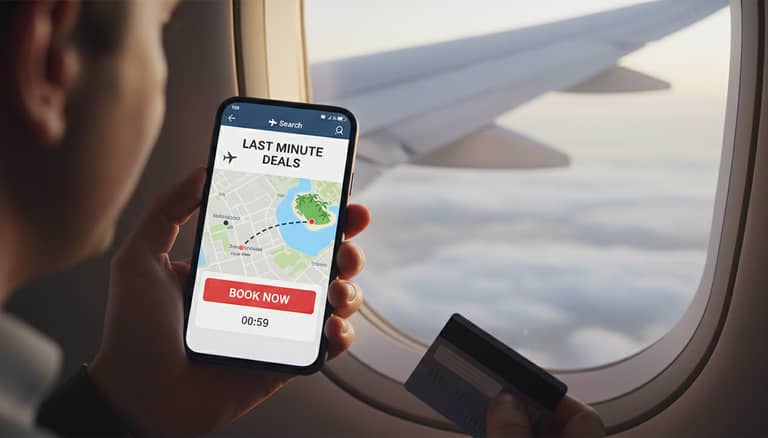
How Last-Minute Flight Booking Really Works in 2025
Written with AI assistance under our editorial guidelines
Last-minute flight booking rarely offers deals despite the popular myth. Around 30% of travelers book within two weeks of departure, driven by psychological factors like the desire for spontaneity and control. However, algorithmic pricing and dwindling options typically result in higher fares, making last-minute booking a high-risk strategy with occasional rare wins that perpetuate the misconception.
You’re staring at your screen, sweat on your brow, pulse thumping in your ears. You need to get somewhere—now. Every tab open is screaming a different price, and every minute brings another spike in fare. Last-minute flight booking has become its own high-stakes sport in 2025, and if you’re not playing smart, you’re almost certainly losing. The myths run deep: “Wait until the last second, and airlines will practically pay you to fill that seat.” Spoiler: That’s rarely how it plays out. The reality, shaped by ruthless algorithms and a travel market still in flux, is far starker—and far more fascinating. This is the unfiltered breakdown of how last-minute flight booking really works now: the psychological traps, the scams, the rare real deals, and the rise of AI-driven platforms like futureflights.ai that are changing the game for good. Buckle up. The truth is rarely comfortable, but it’s your only shot at beating the system.
The wild psychology of last-minute flight booking
Why we wait until the last minute: fear, freedom, and chaos
There’s something primal about the rush of last-minute flight booking. Whether you’re running from, or toward, something—business crisis, broken plans, sudden wanderlust—those final hours before takeoff are a cocktail of anxiety and adrenaline. According to recent studies, around 30% of travelers book their flights within two weeks of departure (Wowfare, Dec 2024), a trend that’s only intensified post-pandemic as flexibility and uncertainty become the new norm. The reasons for procrastination run deeper than laziness or poor planning. Psychologists point to a complex interplay of fear (of missing out, of making the wrong call), the seductive promise of spontaneity, and a culture hooked on instant gratification. Last-minute travel can feel like freedom distilled: a rebellion against routine, a shot at reclaiming control in a world that rarely cooperates.
The paradox? That thirst for freedom often traps us. As airfares surge and choices dwindle, the illusion of agency collapses, replaced by the grim reality of limited options and sky-high costs. Yet, the myth persists. Why? Because every so often, someone scores a unicorn deal—and that story gets told and retold, fueling the cycle for everyone else.

Think of last-minute booking as a high-variance game: the rare win feels epic, but the odds are stacked against you. According to Condé Nast Traveler, 2025, most travelers overestimate their chances of scoring a deal and underestimate the psychological toll the process takes.
Hidden emotional costs: stress, adrenaline, and regret
Booking a flight at the eleventh hour isn’t just a financial gamble; it’s an emotional one. The uncertainty gnaws at you—will prices drop? Will the last seat vanish while you hesitate? Studies in behavioral economics highlight how last-minute decisions amplify regret, especially when a $400 ticket morphs into a $900 splurge within minutes. The “what if” loop is relentless, and the pressure cooker can turn a straightforward purchase into an exhausting ordeal.
“The highest travel costs are paid by travelers who wait until the last minute to book.” — Going.com, State of Travel 2025
The adrenaline rush is addictive, but the hangover—buyer’s remorse, fatigue, even missed flights—can be brutal. For many, the scars of a bad last-minute experience linger, shaping future booking behavior in subtle, self-defeating ways.
The myth of the spontaneous bargain
Everyone wants to believe in the legend of the $50 next-day ticket to Paris. Stories of miraculous last-minute bargains circulate like urban legends—often stripped of details about grueling layovers, hidden fees, or the fact that the traveler had to sleep on an airport floor. Data tells a less romantic story.
| Booking Window (Days Before Departure) | Average One-Way Domestic Fare (USD) | Average International Fare (USD) | % Savings vs. Booking 3 Months Out |
|---|---|---|---|
| 0-7 | $228 | $813 | -12% (domestic), -17% (international) |
| 8-14 | $215 | $799 | -10%, -15% |
| 15-30 | $205 | $790 | -8%, -14% |
| 60-90 (Goldilocks Window) | $180 | $765 | Baseline |
Table 1: Real price dynamics for last-minute flight booking in 2025
Source: Upgraded Points, 2025
The data is clear: the “spontaneous discount” is more myth than method, especially for mainstream routes and reputable airlines. The house always wins—unless you know where to look and how to play.
How airlines really price last-minute seats (and why it’s not what you think)
The evolution of dynamic pricing: from paper tickets to AI
Not so long ago, airfare was simple. Fares were posted on paper, and only insiders really understood the matrix of rules that determined who paid what. Fast forward to 2025, and ticket pricing is a black box powered by ruthless algorithms, real-time demand, and machine learning. Airlines today deploy advanced AI to analyze not just supply and demand, but also personal data, browsing habits, and even device types.
What does this mean for you? The “randomness” you sense when prices dance up and down is anything but random. Every click, every search, every moment you hesitate is potential profit for the airline’s data scientists. According to Going.com, 2025, dynamic pricing now responds to a dizzying array of signals—making consistency a relic of the past.

In this landscape, the edge goes to platforms that can decode these signals, like futureflights.ai, which leverages AI to spot patterns too subtle for humans to catch. The game is no longer about “tricks”—it’s about understanding the system itself.
Glossary: Key terms in airline pricing
The practice of adjusting fares in real time based on demand, competitor pricing, and user behavior. Powered by machine learning and AI in 2025.
A category in the airline’s inventory that determines the price, flexibility, and perks of a ticket. Different fare buckets are sold at different prices for the same seat.
A letter code that denotes ticket rules, changeability, and upgrade potential. Vital for understanding hidden costs and value.
Airline strategy to maximize revenue from each flight, often at the expense of spontaneity.
The real deal with ‘fare buckets’ and booking classes
Every airline seat belongs to a specific “bucket” or booking class. These aren’t just abstract codes—they’re central to how pricing unfolds. The fewer seats left in a cheap bucket, the higher the next available fare jumps. By the time you’re booking last-minute, all that’s left are the priciest classes—unless you get lucky (or find a mistake fare).
| Fare Bucket | Typical Price Range | Refundable? | Change Fee | Upgradeable? | Who Gets It? |
|---|---|---|---|---|---|
| Economy Saver (E) | $100-180 | No | High | No | Early planners |
| Standard Economy (Y) | $180-240 | No | Medium | Sometimes | Flexible travelers |
| Premium Economy (W) | $250-400 | Sometimes | Low | Often | Business travelers |
| Last-Minute (L, Q, H) | $220-400+ | No | High | No | Desperate or spontaneous |
Table 2: Airline fare buckets and their implications for last-minute travelers
Source: Original analysis based on Upgraded Points, 2025, Condé Nast Traveler, 2025
Knowing your fare class can help you anticipate hidden costs or negotiate at the airport. But for the average last-minute booker, it usually means paying the “desperation tax.”
Scarcity tactics: ‘Only 1 seat left!’ and other games airlines play
You’ve seen the panic-inducing banners: “Only 1 seat left at this price!” “Last chance!” Airlines and OTAs (Online Travel Agencies) deploy these tactics to nudge you into booking fast. In reality, these warning signs are often reflections of specific fare buckets rather than actual seat inventory.
“Scarcity is a tool, not always a fact. Airlines want you to feel the pressure—because pressured buyers pay more.” — Condé Nast Traveler, 2025
Of course, sometimes there really is only one seat left. But more often, it’s an algorithmic prompt designed to close the sale. Understanding the difference is crucial: don’t let yourself be played by the system’s bluff.
Busting the biggest myths about last-minute flight booking
Myth #1: Last-minute is always cheaper
It’s the granddaddy of all travel myths. People love to imagine that airlines are desperate to fill planes at the last second and will hand out seats for pennies. But the numbers don’t lie.
| Booking Window | Mythical Price Expectation | Actual 2025 Average Fare | Reality Check |
|---|---|---|---|
| Same week | $100 | $228 | 128% higher than myth |
| 2-3 weeks out | $120 | $215 | 79% higher |
| Goldilocks (1-3 months) | $180 | $180 | Matches lowest |
| Day-of | $80 | $228-$400+ | Up to 5x the “myth” |
Table 3: Comparing myth vs. reality for last-minute flight prices
Source: Upgraded Points, 2025
The brutal truth: last-minute usually means paying more. Occasionally, a last-ditch fare will drop if a flight is truly empty, but that’s the exception, not the rule.
Myth #2: Incognito mode guarantees better prices
Countless blogs swear that searching in incognito/private browsing mode keeps prices low. The idea is that OTAs and airlines “punish” repeat searchers by hiking fares. But real investigations show this is mostly urban legend.
Current research from Economic Times, 2025 found negligible fare differences between incognito and normal browsing. Dynamic pricing is more influenced by genuine demand and inventory than your browser cookies.
“Incognito mode offers psychological comfort more than real savings.” — Economic Times, 2025
If you see a sudden price jump, it’s likely due to demand or fare bucket changes, not your browsing habits.
Myth #3: Apps and bots can hack the system
A cottage industry has sprung up around “flight deal apps” and “booking bots” promising secret fares. While some tools (like fare alert apps and AI-driven platforms) offer real advantages, plenty sell snake oil.
- Many “deal” apps simply reskin standard OTA data—no better than searching directly.
- Some bots violate airline terms and can get your booking canceled or flagged as fraud.
- True AI-driven engines (like futureflights.ai) harness live data and sophisticated algorithms to surface legitimate last-minute options, but there are no magic bullets or hacks.
Blindly trusting any app or bot is a recipe for disappointment. The smart move is to use reputable tools, cross-check prices, and stay skeptical of anything promising “guaranteed” savings.
The dark side: scams, phantom deals, and hidden fees
Spotting red flags: what real last-minute deals never look like
Last-minute booking is a magnet for scammers exploiting desperation and haste. Some warning signs that should set off alarm bells:
- Prices far below market average for major airlines or routes—if it looks too good to be true, it probably is.
- Demands for payment via non-traceable methods (wire transfer, crypto, gift cards).
- Shady third-party sellers with no digital footprint or poor online reviews.
- Pressure to decide “within seconds” or lose the deal, without time to verify.
- Lack of clear terms for changes, refunds, or cancellations.
Proceeding without due diligence can lead to lost money, no ticket, or, worse, identity theft.
Hidden fees airlines hope you miss
Even legitimate last-minute fares come with traps. Budget airlines, in particular, lure you in with a low upfront cost, then pile on the extras.
| Fee Type | Typical Cost (USD) | Applies To | Hidden Danger |
|---|---|---|---|
| Baggage Fee | $30-70 per bag | Almost all budget | Charged at check-in |
| Seat Selection | $10-45 | Many carriers | Defaults to random seat |
| Change Fee | $50-200 | Most basic fares | Often per segment |
| Meals/Snacks | $5-25 | Budget, some legacy | Not included |
| Priority/Boarding | $15-60 | Budget, legacy | “Optional” but nudged |
Table 4: Typical hidden fees in last-minute flight booking (2025)
Source: Original analysis based on Upgraded Points, 2025, Condé Nast Traveler, 2025
Always factor in total cost—including extras—before hitting “book.”
Real stories: When last-minute booking goes wrong
Behind every viral “deal” story is a counter-story of disaster: missed connections, non-existent tickets, or outrageous add-on costs. Take the case of Mark, who booked a “too good to be true” flight to Rome for $199 from a little-known agency. The e-ticket never arrived. Mark lost both his money and his vacation, joining a growing legion of travelers burned by online scams.
“I should have checked the agency’s reputation. The stress and loss of trust were worse than losing the cash.” — Mark T., Cautionary Traveler, 2025

These stories are reminders: urgency is no excuse for abandoning common sense. Always verify your source—especially with last-minute bookings.
Insider strategies for scoring a real deal (without losing your mind)
Step-by-step: From panic to boarding pass in under 60 minutes
Booking at the last minute isn’t always a bloodbath—if you move smartly and avoid rookie mistakes. Here’s a battle-tested sequence:
- Set alerts on multiple platforms: Use fare alert services and reputable AI-driven engines (like futureflights.ai) to catch sudden drops.
- Search flexible dates and nearby airports: A shift by even one day or one city can slash hundreds off fares.
- Check budget and legacy carriers separately: Don’t assume aggregator sites include all airlines; some low-cost carriers sell direct only.
- Factor in total cost: Include fees for bags, seat selection, and meals before comparing fares.
- Book directly when possible: For urgent travel, booking direct can speed up issue resolution and refund processes.
- Verify payment and ticket receipt: Double-check confirmation emails and monitor for suspicious activity on your credit card.
- Prepare for plan B: If the flight vanishes during booking, have backups ready to go.
By following these steps, you stack the odds in your favor, even when time is not.
Unconventional hacks for the savvy and desperate
Some tricks aren’t widely publicized, but seasoned travelers swear by them:
- Book one-way on different airlines: Sometimes piecing together legs saves money, even if it’s more effort.
- Use travel rewards or credit card points: Points can be less affected by last-minute price surges; some cards offer emergency booking perks.
- Explore alternate cities: Major hubs nearby may offer drastically cheaper options.
- Join airline standby lists at the airport: In rare cases, showing up in person can net a last-minute seat at a discount.
- Leverage business travel portals: Some companies have deals or block seats for employee emergencies; check if you qualify.

Flexibility is king; the more variables you can tweak, the better your shot at a “win.”
Checklist: Critical steps before you hit ‘book’
Don’t let desperation cloud your judgment. Run through this checklist every time:
- Verify the seller: Google the agency, check reviews, and look for customer complaints.
- Confirm final price: Check that all taxes and required fees are included in the total.
- Check fare rules: Review change, refund, and cancellation policies carefully.
- Inspect layovers and connections: Avoid too-tight layovers or risky airport changes.
- Double-check passenger info: Even minor errors can derail a last-minute booking.
- Back up your documentation: Save e-tickets, receipts, and itinerary offline.
By pausing for these essentials, you can avoid most last-minute pitfalls—and keep your sanity intact.
How AI and LLMs are changing last-minute flight booking forever
Inside the algorithms: What really drives dynamic offers in 2025
The old model of static pricing is dead. Airlines now deploy dynamic, data-driven models that reevaluate fares in real time, factoring in everything from booking history to seatmaps to global events. AI and large language models (LLMs) digest massive datasets to predict traveler intent and price sensitivity, generating offers that are both personalized and profit-maximizing.
| Factor Influencing Fare | How It’s Used | Impact on Last-Minute Bookings |
|---|---|---|
| Real-time demand | Surges price as seats fill | Drives up last-minute fares |
| User device/browser | May show different prices based on tech | Small, but real effect |
| Loyalty status | May trigger special offers or upgrades | Sometimes mitigates “desperation tax” |
| Search patterns | AI predicts intent and urgency | Higher fares for urgent searches |
Table 5: How modern AI influences last-minute pricing
Source: Original analysis based on Condé Nast Traveler, 2025, Going.com, 2025
The rise of AI-powered search: from guesswork to precision
What separates the winners from the losers in last-minute booking is access to AI-powered platforms that can crunch more data, faster, than any human. Tools like futureflights.ai analyze fare trends, seat maps, and personal preferences in real time, surfacing options that would take hours to uncover manually.

The result? Less guesswork, fewer regrets, and a higher chance of landing a genuine deal. But even the smartest AI can’t conjure a seat that isn’t there—so using these platforms is about maximizing your odds, not gaming the system.
Why futureflights.ai is a sign of what’s coming
Platforms like futureflights.ai aren’t just digital travel agents; they’re a glimpse into the future of booking itself. By integrating advanced LLMs and machine learning, they offer recommendations that are deeply tailored to your needs and adapt in real time to shifting market dynamics.
“Personalized, AI-driven booking is rewriting the rules—leveling the playing field for ordinary travelers in a game once rigged by insiders.” — Editorial analysis, 2025
This isn’t just hype. As algorithms grow more sophisticated, the divide between the well-informed and the merely hopeful will only widen. In 2025, knowledge isn’t just power—it’s dollars saved and stress avoided.
Case studies: When last-minute paid off (and when it backfired)
The miracle upgrade: How Lisa turned chaos into first class
Lisa had just three hours to get from New York to London for a family emergency. All direct flights were sold out or astronomically priced—until an AI-powered alert on her phone surfaced a last-minute cancellation in business class. She booked on impulse; the price was still high, but less than economy for the next day. On arrival, she was bumped up to first class due to an overbooking error. Her chaos, for once, netted a windfall.

Lisa’s story is rare, but not a fairy tale. Platforms like futureflights.ai can spot edge-case opportunities that reward the patient—and the lucky.
The $900 mistake: When waiting cost more than planning ahead
Contrast that with Tom, who delayed booking a cross-country trip in hopes of a price drop. Instead, fares spiked as the departure date neared, turning his $300 plan into a $1,200 expense. He paid the premium or missed his cousin’s wedding.
| Booking Delay | Expected Fare | Actual Fare Paid | % Overrun | Outcome |
|---|---|---|---|---|
| Booked 90 days out | $310 | — | — | N/A |
| Booked 7 days out | $400 | $1,200 | +200% | Overpaid |
Table 6: How waiting for a “deal” backfired for a real traveler
Source: Original analysis based on Upgraded Points, 2025
Lesson: The “wait and win” approach can turn into a costly mistake, especially during peak travel periods.
Traveler hacks: Real-world tips from the unflappable
- Always have backup options: Check both direct and connecting flights for last-minute openings.
- Travel light: Avoid fees and move faster by packing only a carry-on.
- Use AI tools and alerts: Let technology do the heavy lifting while you focus on logistics.
- Know your rights: Understand airline policies on cancellations, delays, and refunds.
- Don’t chase mythical unicorns: If the fare looks too good, vet it twice.
“Smart last-minute booking is less about luck and more about preparation—plus a touch of technological hustle.” — Veteran Traveler, 2025
The global perspective: Last-minute booking around the world
Why last-minute deals are better (or worse) in Europe, Asia, and the US
Travel isn’t the same everywhere. Regional quirks, regulations, and market dynamics shape how last-minute fares play out.
| Region | Average Last-Minute Fare | % of Seats Sold at Last Minute | Typical Success Rate for Deals | Notes |
|---|---|---|---|---|
| US | Highest | 25% | Low | High demand, low flexibility |
| Europe | Moderate | 35% | Moderate | More low-cost carriers, but many fees |
| Asia | Variable | 30% | Mixed | Mix of legacy and budget |
Table 7: Last-minute flight booking by region in 2025
Source: Original analysis based on Expedia, 2025, Condé Nast Traveler, 2025

In Europe, budget carriers dominate short-haul routes, sometimes making true last-minute deals possible. In the US, legacy carriers’ grip keeps prices high and flexibility low. In Asia, the experience is mixed—budget and full-service options abound, but cultural and regulatory factors often dictate terms.
Cultural and regulatory quirks that shape travel surprises
Beyond pricing, local customs and laws play major roles in last-minute travel outcomes.
In the EU, compensation laws for delays and cancellations offer a safety net, while in the US, travelers have fewer rights outside of voluntary airline policies. In parts of Asia, cultural norms affect how “standby” or “walk-up” fares are handled.
Key terms defined
European regulation that grants compensation for significant flight delays or cancellations—vital for risk management in last-minute travel.
A reduced-fare ticket for passengers willing to wait at the airport without a confirmed seat. More common in Asia and among airline employees.
A booking that allows arrival in one city and departure from another, often used in creative last-minute itineraries.
Last-minute booking in 2025: Future, freedom, or trap?
Is spontaneous travel the new luxury—or just a myth?
For all the Instagram-fueled fantasies of hopping a plane at a moment’s notice, spontaneous travel is less accessible—and less affordable—than ever before. Airlines have mastered the art of squeezing out profit from every seat, and the digital tools that once leveled the playing field now serve those who know how to use them.
“True spontaneity in travel is now a privilege reserved for those with the flexibility, resources, and know-how to beat the odds.” — Editorial, 2025
For most, the dream of the last-minute bargain is a mirage. But for the well-prepared, victory is possible—just rare.
Environmental impact: Are last-minute flights dirtier?
Urgency often means flying less efficiently: empty seats, suboptimal routings, and older aircraft. Here’s how last-minute fares stack up for environmental impact.
| Factor | Last-Minute Booking | Advance Booking | Explanation |
|---|---|---|---|
| Plane occupancy | Lower avg. | Higher avg. | More empty seats, higher emissions per passenger |
| Aircraft age | Older (sometimes) | Newer | Less efficient, used for overflow |
| Routing | More connections | Direct flights | Longer distances, more emissions |
Table 8: Environmental impact of last-minute flights vs. advance booking
Source: Original analysis based on Economic Times, 2025
The upshot: last-minute flying can be more polluting, especially on less efficient routes.
What real experts want you to know before you book
- Book early unless you have to wait: The best fares are still found in the “Goldilocks window”—1-3 months out for domestic, 3-5 for international.
- Be flexible with dates and airports: That’s where the real deals are hiding.
- Use trusted, AI-powered tools: They won’t work miracles, but they’ll give you the best shot at avoiding disaster.
- Watch out for scams and hidden fees: Desperation is a scammer’s best friend.
- Read the fine print—always: Last-minute means less wiggle room for changes or refunds.
If you’re determined to book last-minute, go in with your eyes wide open, armed with data and skepticism.
Conclusion
Last-minute flight booking isn’t the digital Wild West it’s made out to be—at least not for those who value their sanity (and savings). In 2025, the reality is sobering: prices surge, choices shrink, and the myth of the spontaneous bargain is, for most, just that—a myth. But hope isn’t lost. Armed with current research, a clear-eyed view of psychology and risk, and the power of AI-driven tools like futureflights.ai, you can wrestle back some control from the system. The keys: flexibility, preparation, and ruthless skepticism about too-good-to-be-true offers. Don’t let desperation dictate your journey. Instead, become the rare traveler who knows that the only real hack is knowledge itself. Ready to stop chasing unicorns? Start exploring smarter, and let the odds tilt—finally—in your favor.
Sources
References cited in this article
- Upgraded Points Study(upgradedpoints.com)
- Condé Nast Traveler(cntraveler.com)
- Going State of Travel 2025(going.com)
- Economic Times(m.economictimes.com)
- Wowfare(wowfare.com)
- AIS Electronic Library(aisel.aisnet.org)
- San Diego Union-Tribune(sandiegouniontribune.com)
- TravelPerk(travelperk.com)
- ASAP Tickets: Psychology of Last-Minute Bookings(asaptickets.com)
- OAG Dynamic Pricing(oag.com)
- Mighty Travels(mightytravels.com)
- OAG Blog(oag.com)
- Forbes(forbes.com)
- Simple Flying(simpleflying.com)
- Kody Technolab(kodytechnolab.com)
- Going.com Guide(going.com)
- Dollar Flight Club(dollarflightclub.com)
- Expedia 2025 Air Hacks Report(prnewswire.com)
- MightyTravels Scam Alert(mightytravels.com)
- MoneySavingExpert(moneysavingexpert.com)
- Going.com Last-Minute Guide(going.com)
- TravelFreak(travelfreak.com)
- CheapTripsGuide(cheaptripsguide.com)
- ForeFlight AI in Aviation(ba.foreflight.com)
- PROS AI Flight Search(pros.com)
- Velocity Ventures(velocityventures.vc)
- AIMojo(aimojo.io)
- Virtasant: Airline AI(virtasant.com)
- ClickTravelSave(clicktravelsave.com)
Discover Flights Beyond Imagination
FutureFlights.ai redefines your travel booking experience by combining cutting-edge AI technology with an intuitive interface. Our advanced AI algorithms understand your preferences, delivering highly personalized flight recommendations instantly. Say goodbye to tedious searches and generic results—FutureFlights.ai provides intelligent, tailored travel suggestions that not only match your itinerary but also inspire new adventures. Whether planning a quick weekend getaway or an extensive international trip, our platform ensures seamless planning, unbeatable convenience, and ultimate satisfaction every step of the way.
Get startedReady to Discover Your Next Adventure?
Experience personalized flight recommendations powered by AI
Frequently Asked Questions
What percentage of travelers book flights last-minute?
According to recent studies cited in the article, around 30% of travelers book their flights within two weeks of departure, a trend that has intensified post-pandemic.
Why do people tend to book flights at the last minute despite higher costs?
The article explains that last-minute booking is driven by a complex mix of psychological factors including fear of missing out, the seductive promise of spontaneity, desire for freedom, and a culture hooked on instant gratification, often creating an illusion of control and agency.
Is the myth that airlines offer cheap seats at the last minute true?
No, the article states this is a spoiler myth that rarely plays out in reality. Instead, airfares typically surge and choices dwindle in the final hours before takeoff, though rare deals do occasionally occur.
What does the article identify as changing the last-minute flight booking game?
The article mentions AI-driven platforms like futureflights.ai as forces that are changing how last-minute flight booking works.
More Articles
See more from Intelligent flight search

Last Minute Flights: What the Data Reveals About Late Bookings
Last minute flights rarely deliver the bargains promised. This article examines outdated advice, how airlines price dynamically, and strategies that work today.

How Best Last-Minute Flight Finders Work Against Airline Pricing
Best last-minute flight finder tools use AI to spot deals, but airlines employ algorithms to raise prices.

How Last-Minute Ticket Finders Exploit Urgency and Delay
This article examines how last-minute ticket finders work, why airlines exploit urgency, and which strategies actually reduce ticket costs when time is short.

Last-Minute Flight Booking: What Actually Works Versus Airline Tricks
This article explains how to book last-minute flights effectively. It covers airline pricing strategies, common traps, and research-backed methods for finding genuine deals.

Last-Minute Flight Deals: How Airlines Control Pricing
Last-minute flight deals attract travelers seeking bargains, but airlines use algorithms to control pricing.

Last Minute Flight Deals: When Prices Drop and When They Don't
Last minute flight deals rarely deliver rock-bottom fares. This article examines the odds, common traps, hidden fees, and rare scenarios where prices actually drop before departure.


